Heart of the (h)earth

Deepavali is the festival of lights.

Literally, a row of lights (Deepa – lamp light, avali – row) lit to dispel darkness, celebrated on a new-moon night, in the Indian calendar month of Kartik.

Many mythological stories and legends abound on the events that led to celebrating the festival of lights, with a regional flavour – as also the origins and types of fire-crackers used, but all that’s for another day.
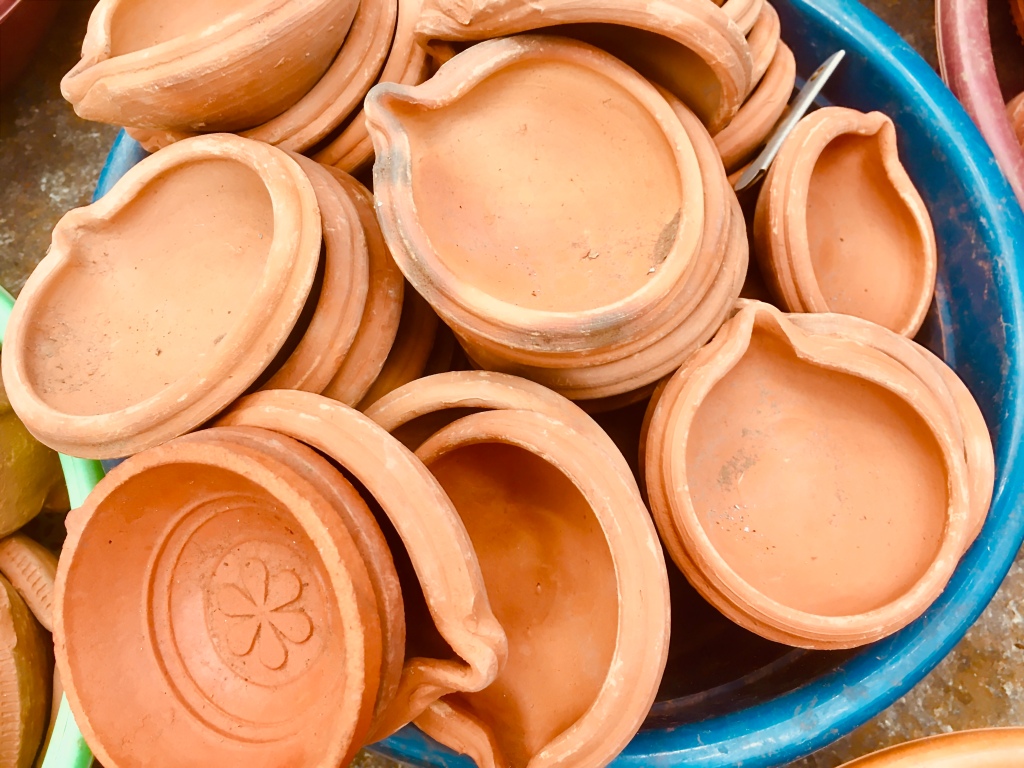
Handmade earthen lamps stacked in a plastic bowl

Lamps made of clay have a native charm. The handmade red-ochre deepa are traditionally made by potters, painstakingly following age-old pottery techniques. Earthen Pottery in India can be traced back, historically, earlier to 2,000 BCE, or beginning of the Harappan civilisation.

Scouring Bangalore’s markets for handmade earthen lamps/deepa was a learning experience. Though we had always sought earthen lamps, ‘handmade‘ was of special focus this Deepavali – for various reasons – a) they are easier to make, b) consume lesser clay per piece, c) easily return to earth, d) of course, cost less.

The potter’s clay is a mixture of soft soil taken from river basins and village tanks, fertile soil from irrigation water-structures, and sand from river beds. The mixture is wetted with water, left for a week to sag and then stomped continuously for a couple of hours for a smooth texture. The softened clay is then hand-crafted into little deepas. Once the wares are made, they are left to dry in the sun for two days (coloured with red-ochre in some areas) and then baked in an earthen oven / kilns at 120 degrees for 12 hours. Stacks of hay, field-straw, twigs and even dead branches of native trees are used as fuel. Naturally, earthenware flourished in the regions where large perennial-rivers flowed. Though few rivers died (like the Saraswati), the craft sustained or adapted to new situations.

Across India, regional techniques of clay pottery evolved over centuries, and continues to this day – most notable are: Kangra in Himachal, Mansa, Bankura, and Midnapore in West Bengal, Alwar and Molela in Rajasthan, Nizamabad and Prayagraj  in UP, Kutch and Saurashtra in Gujarat, Delhi-Haryana region, Thane and western Maharashtra; in the South, the loamy soil of Manamadurai and 15 surrounding villages in Tamil Nadu dominate the deepa market, while Kerala’s Peringottukurissi near Ernakulam, Peruvemba and Ezhumangad near Palakkad, Doora in Mysore dist, Khanapur near Belgaum, Chitoor dist of Andhra, and n small pockets of Konkan, Goa and Pondicherry are the others.

Many of the potters, Kumbhars (kumbh – pot), have carried their regional traditions over generations. Of them, very few continue to make deepas by hand – most have switched to moulds. Down a slippery slope, the art is on the wane – lack of skill lead in the current generation led to poor quality and resultant breakage (both handling and transport). Evidently, moulded lamps are more sought after by makers and sellers. Historically, there have been many forms / types of lamps used in festivities, including stone, brass, bell-metal, silver, even gold. Temples especially preferred deepa stambha (pillar of lamps) made of stone (granite of choice).
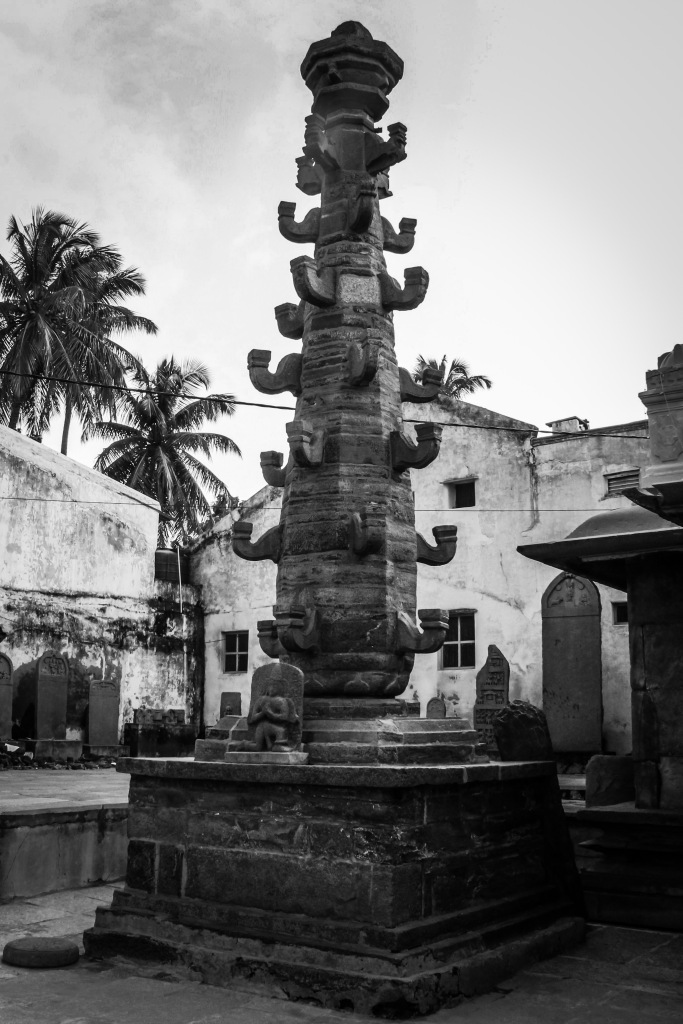
Elaborately decorated, intricately carved Deepa Stambha of single granite rock,
at Sri Harihareshwara Temple, Harihar – built in 1224 AD by a Hoysala general Polalva

A potter uses ~75 kgs of clay for a thousand handmade deepa of 2” dia in a day; while moulded ones require almost double the quantity but lesser time. Cost-wise, handmade ones sell Rs. 30 per doz in the cities, for simple elegant types without flashy paints, kitsch; while mould ones cost double. Traditional deepa are preferred, but lesser in demand and the cheap imported plastic items have taken over the scene.

Led fairy lights, plastic/paper lanterns, or wax candles, pale in comparison to the warm-glow of the earthen lamps – they are not only friendly to the earth but also provide livelihood to the thousands of kumbhars, who live in poverty and infinite-debt.

The lady from whom I ultimately bought the handmade lamps revealed that 90% of earthen lamps sold in Bangalore come from TN. Our own Pottery town is in shambles, as many potters shifted out over the years, and those who have remained are content making commercially viable articles like planters, water-pots, even kulhads / tea-cups. Deep search yields moulded earthen lamps upon coaxing, that too in joint-family-homes where older generations still exist.

Lighting lamps are a means to not only get rid of darkness, but also denotes dispelling anger, greed, hatred and all such unwelcome feelings. The lamps also stand for good luck. The traditional deepa were lit using cow-ghee or til/sesame seed oil or coconut oil in coastal areas with wicks made of cotton; but recently, various oils and blends are used in the name of ‘deepam-oil’.

A lamp lit with ghee emits satvik vibrations and thus completes the wholesome spiritual experience. an oil lamp too emits positive vibrations, but at a lesser frequency. It is also said, the fumes and heat generated from a ghee-lamp are beneficial in health perspective; which isn’t the case with oils, especially the recent blends, which contain mineral oil (refined waste machine-oil derived from petrol), Paraffin, and Palm oil.

Did you know?
Earthen lamps, called Deepa in Sanskrit and its derived dialects across India, diya in Hindi-Arabic, vilakku in Tamil-Kerala, pramida in Telugu, matira-pradipa in Bengali, among others.
Terracotta originated from terra cocta, meaning earth-baked in Italian, and includes both glazed and non-glazed pottery. It has come to be used as a common term for all earthen items across the world.

A Sanskrit shloka encapsulates the essence of lighting a lamp:

शुभं करोति कल्याणमारोग्यं धनसंपदा ।
शत्रुबुद्धिविनाशाय दीपज्योतिर्नमोऽस्तुते ॥
That which bestows auspiciousness, health, wealth and prosperity,
which destroys inimical feelings and hatred,
Salutations to the light of the lamp!

This year, Deepavali is special; the world is going through a tricky but deadly pandemic, which is seen waning one day, but resurfacing with a vengeance the next! India is the second most affected nation and there isn’t a cure worth of mention. Precautions to avoid Covid-19 ought to continue, and festivities should be muted, celebrated in spirit.

So, keep it earthy, simple, and stay safe!

Shubh Deepavali!
शुभ दीपावली!
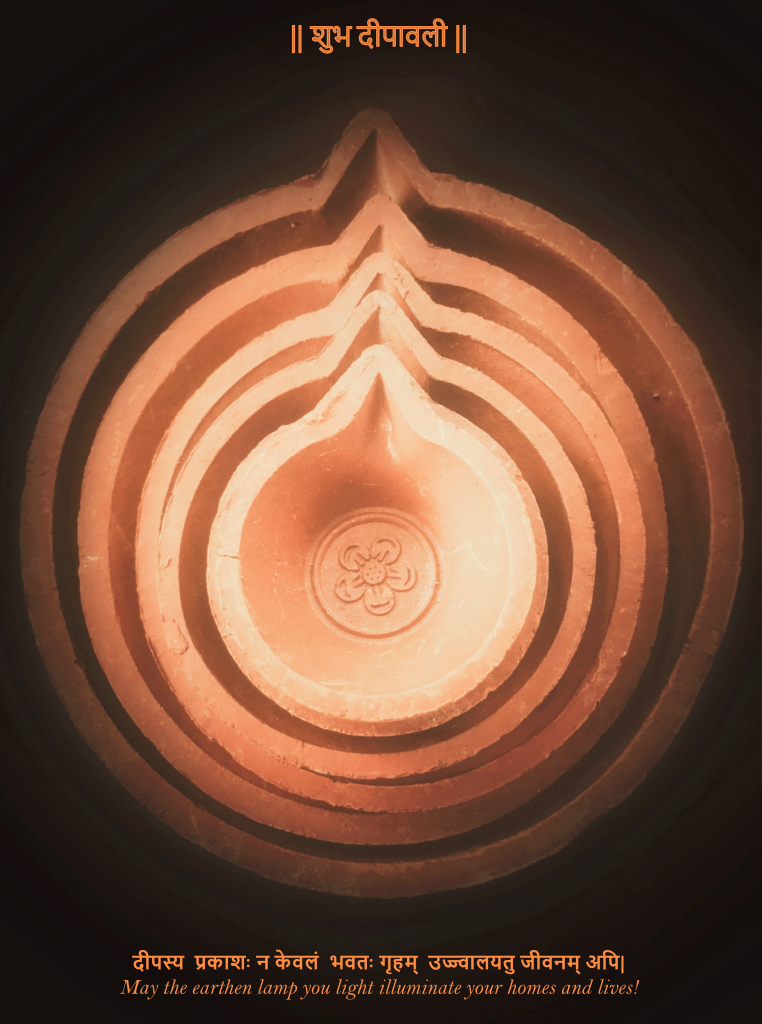
Images in this post belong to the author. Information gleaned from various sources, incl kumbhars,sellers and the net.


Earth toDay

AS we speak, billions of people across the Earth are cooling heels at home, practicing own methods of social distancing based on their own understanding of the severity of the Coronavirus pandemic.

This unique situation imposed upon us by the potentially dangerous pathogen, proliferated by human excesses and abuse of nature, its resources and constituents or just stupidity. Now, whether it is man-made or nature’s gift is subject to speculation and various debates are on both scientifically and politically motivated. Whatever be the case, as on date 25+ lakh people are infected, ~7.5 lakh have recovered, and ~1 lakh have died, majority in the most powerful nation, the US followed by Europeans. All this mayhem in a just over 100 days since it was discovered in Wuhan, China, and ~80 days since WHO declared Covid-19 as a pandemic – the coronavirus has spread to every continent, except Antarctica, affecting 211 countries. Each country has reacted differently, few instructed with force, some advised its citizens to keep away from each other.

Social Distancing is the new normal. Covering up and practicing hygiene is not even an option any more.

World economy suffers terribly, Countries would lose Trillions, if not Zillions in trying to keep businesses afloat, to ensure people out of jobs are supported in some way, the poor and homeless would get food to eat – while fighting to keep the virus in check. The new Coronavirus isn’t as bad as it is made out to be – with an infection rate of 4k/ml in Spain to XX% and a death rate ranging between 13.3% in Italy to 0.56% in Iceland; common seasonal influenza virus claims 6.5 lakh people worldwide.

The rainbow in this worldwide storm: Nature, undisturbed by human activities and interventions, aided by countries under various stages of lockdown in the past month, is cleaning up, and the environment starts to feels fresh again. Rivers, flowing with urban wastewater for decades and declared dead, are now clean and water is fit to drink! Air pollution is at its lowest, with clear skies. Hopefully, once the virus’ imperious march stops in its tracks, humans will emerge healthy, fit and immune to Covid – and more importantly, very concerned to protect and improve the environment.

Meanwhile, the world is continuing to witness the impact of unsustainable and sometimes dangerous practices – vanishing rainforests and graveled hills, drying up lakes and under groundwater streams, polluted air- water-land, farming, (agri-poultry-aqua), soil degradation and beach erosion, ethnic tribes losing ancestral abodes, hundreds of species staring at extinction, dying bees and butterflies, man-wild conflict, unbridled change of land use, waste generation, unsegregated disposal and landfills, hoarding essentials, excess consumption, plastics manufacture, usage and unethical disposal, burgeoning cities scrambling to feed increasingly migrating labour and what not!

Is Coronavirus the catalyst that our Earth desperately needs, to mitigate centuries of misuse and exploitation, to rejuvenate?

The Arctic Ocean in summer will very likely be ice free before 2050, at least temporally, according to new research. A new study says a megadrought worse than anything known from recorded history is very likely in progress in the western United States and northern Mexico. Himalayan glaciers are melting faster than previously thought,

Actually, it could be worse. Powerful companies, from developed countries, impoverished with weeks of lockdown and Govts with economic inactivity in addition to sustaining their economies will look to rebuild on the rebound and capitalise the increasing demands of markets. Environment conservation and related budgets take a back seat, since in the short term the resources visible at hand are perceived to have improved. The climate could become even more degraded than it was in December 2019.

It will be challenging, as it has been over the years. Now, with the respite provided by Coronavirus, Govts could be influenced with concerted efforts by the society, combined with great political will, the environment can be further improved and clean climate can sustain. We must realise the and take advantage of this unexpected window of opportunity that has been provided to humankind.

On the 50th anniversary of the Earth Day, let us take the pledge to adopt sustainable lifestyle, adopt earth friendly products and practices,

Respect Nature, Plant native trees, Conserve water and energy, Buy local, Stop buying/using plastic, Use public transport or Car pool, Use renewable energy, Reduce dependency on fossil fuels, Build with sustainable materials.

Stay Home, Stay Healthy, Be Positive!

A new dawn for a cleaner greener future!

Photo credits: Blue Marble – courtesy NASA; New Dawn: From own archives. Statistics from internet, text in parts adapted from NASA.

E-lectric and a lot of Cloud

India’s thirst for EVs (Electric Vehicles) received a major push in India’s Union Budget of 2019-20, and is expected to improve further in the budget of 2020-21 and thenceforth.

In March 2019, India’s union cabinet approved setting up of a National Mission on Transformative Mobility and Battery Storage, to drive clean, connected, shared, sustainable and holistic mobility initiatives. The proposed capacity target for lithium-ion battery-manufacturing base has been raised to 50GW from 40GW. The government is in the process of tendering for set up of 50GW battery manufacturing base at around US$50 billion investment.

While this is good news, there is total ignorance among majority of general public.

“At Mahindra AGM our shareholders asked us when are we getting into EVs. If after producing and selling EVs for 9 yrs, after having 5,000 eCars on the Indian roads, after 135 M eMiles behind us if our share holders don’t know that we make EVs, we have failed in our communication,” said Dr Pawan Goenka, the head of Mahindra, a day after the recent AGM in Mumbai. Mahindra have the most diversified indigenous range of e-auto products in India currently – the sedan E-verito, e-Supro minivan and E2O+ Hatch as also 3-Ws Treo and e-Alfa mini. Mahindra is setting up an advanced Lithium-ion battery plant along with the Korean LG Chem at Chakan near Pune – half-a-million modules per year.

Indian rules say that assembling cells within the geography of the country is enough to quality under Make-in-India. This means, the cells are imported – largely from Taiwan and China, and doesn’t have the competence to manufacture the cells itself. The recent COVID-19 situation and resultant lockdown in China has led to severe shortages of various types of rawmaterial used in a wide variety of industries, including EVs – prompting Mahindra to state that BSVI roll-out would be delayed, while mobile companies said they could shut for at least a 10 days – if things don’t improve at China and components supply is hampered further.

In an already weak manufacturing situation (Auto sales down ~40% in 2019-20), this is the last thing that industries had expected / wanted. But viruses have a mind of their own, and our minds are clouded. This was an opportunity for Indian industries to step-up and grab their share of the global market. Well, elephants seldom dance, let alone fly, and panic when in stress; Elephants are cute and majestic, though!

A lithium-ion battery accounts for 40% of the total cost of an EV. Toshiba-Denso-Suzuki JV has invested in a 1,100 cr lant in Gujarat for Li-ion batteries. Panasonic plans to step into this field as well. an EV battery manufacturing set-up could cost ~200 crores, which only deep pockets can afford. While collaboration could mitigate the technology development costs, everyone prefers to climb the wall to discover the struggle for themselves. Mahindra on its part is willing to find synergies with Tata Motors.

EVs must fire-up before losing charge

The recent Auto Expo 2020 at Noida in Feb, threw up 18 EV startups and their wares – autos, mopeds, bikes, scooters and a Bus. Of all, only one was Arai certified, the rest being concepts. AutoExpo 2019 had 11 startups, but majority of them haven’t seen significant growth nor have captured the market.

Large Auto companies – Mahindra, Tata motors, Maruti and Volkswagen too displayed their current options and concepts; remains to be seen how these get accepted by the public. In the period Apr-Dec 2019, only 1,554 4W EVs were sold! A host of launches were made by Kia, Tata and Hyundai, and their marketability remains to be seen, in the tepid waters. The fate of EVs from BMW, Mercedes is anybody’s guess. An improvement in the EV market was the jump in sales – 2017: 56,000 EVs, 2018-19: 759,000 EVs – mostly in 2W and 3W. The crux is – individual 4W-EVs sales is not forging ahead as anticipated and the current numbers are largely of call-rider companies purchases. Experts believe that current crop of 4W-EVs are at best a second car, and the first time buyer or first choice of car still will continue to be powered by fossil-fuel. How many can afford a Tesla Electric in the world?

Hero Electric (11 2W-EV models!) is gingerly testing waters; Bajaj went retro and announced an Electric version of the legendary Chetak (remember Buland Bharat ki Buland Tasveer? but how Hamara will this Bajaj be, with Rajiv hating the e-word). Elsewhere in the globe, Sony built a Vision-S car; so why not our own Micromax build a Revolt bike? Should big boys have all the e-fun?! Yulu is a flimsy moped, but it is in shared rides cocoon with limited mobility, I was petrified riding one for 300-mtrs at a stretch. Then there are the Okinawa, Battre, Ultraviolette, Tork… all e-attempting. There is a star, though, in Ather, powered by ex-Flipkart’s Bansals, Tiger Global and Hero Motocorp, which seems to be leading in the 2-W market for now, and intends to invest Rs 635 crores for a manufacturing plant at Hosur, which will double their current capacity of 40,000 2-W-EVs pa., and have reportedly invested in putting-up 40 public charge stations in Bangalore and Chennai.

Given the cost of charging infrastructure, Govt needs to step in to bolster this critical public infra countrywide (2,346 charging stations in 24 states is a slow start), if it is serious about 2030 deadline (hope it doesn’t peter out like the recent Plastics Ban fiasco!). At present, at SMEV there are 28 EV manufacturing companies in their fold while the rest of the total 72 members are into components alone. https://www.smev.in/smev-members. Can a startup rise to manufacture charging stations in India? An exuberant elephant calf, perhaps?

How green is my power? If fossil fuels are responsible for increase of CO2 in the atmosphere, Coal is a co-culprit with 40% contribution. Besides, when burnt, coal produces pollutants like sulfurdioxide, mercury, and particulate matter which result in acid-rain and damage the environment. Not to mention serious ecological damage done to the forests due to mining and transport. In India, 62.80% is generated by thermal plants, Hydro and Nuclear provide 12 and 2% respectively, while Renewable power is a healthy 23%.

Alternate energy: When we talk of energy sources like Hydel, Solar, Wind and Nuclear energy, they seem to be the best solution. But are they? It is laudable that UN sees India leading the global thrust, but it still doesn’t feature in the list of top 10 countries that are ready to transition into a secure, sustainable, reliable, and affordable alternate energy future. According to WEF, 81% of global energy systems is still dependent on fossil fuels and so is India. Solar panels have a life of say, 25 years, with diminishing performance and degrading of panels; then what? What to do with these panels… manufacturers like Tata Solar, Vikram, Emvee, have no clue, yet. US and Europe are in planning stages with pilots running. Though the panel (made of glass, silicon, plastic and aluminium) is recyclable, it is difficult to extract the web of metals to reuse, and could end up in landfills; but then – where is so much of land? Wind Farms are falling out of favour – with erratic wind patterns, poor generation and transmission losses, maintenance glitches, high initial infra cost coupled with mounting financial burden, not to mention damage to sensitive eco-system in remote areas (dizzy wild animals, dying bees, et al). EV’s batteries are made largely of Lithum which is again a mined RE metal with limited resources worldwide.

Clear Policies: Indian Govt specifically needs to focus on reducing imported parts for EVs if the local industry (already reeling on slackened auto market) has to find their mojo once again. Incentivising home-production and increasing duty on imported CBUs, parts and components, will be a good start – given that EVs require ~800 lesser auto-components than conventional ones (a survey in Germany found out and that it could also mean a million-job-loss). Increasing common charging points in public spaces, a specific policy for end of life battery cases and solar panels that cannot be recycled must be put in place forthwith, or else we will be filling the Earth with more toxins and rare-earth substances in an effort to save fossil fuels!

Alternate Green energy: ET Energy quotes TERI in a recent article, that India’s 18 sq km surface area of reservoirs has the potential to generate 280 GW of solar power, using floatovoltaics; this report was tabled at the recent World Sustainable Development Summit 2020; given the high costs of land acquisition this seems to be an alternate to generating green-energy. China, Japan and South Korea are said to be leaders of this floating-power-generation technology, while UK has the world’s largest farm. Floating Solar Farms, of 50 MW to shortly take-off in Kerala by National Hydro Power Corpn; but before rushing to establish this unique tech, must consider possible ecological damage to the biodiversity and aquatic life. In a study of one such farm by Kyocera TCL Solar LLC at the Yamakura Dam reservoir in Japan found reduction in algal blooms reduced evaporation of water, and the blocking of UV rays, while being difficult to maintain and prone to damage, but on the plus side, the panels generated more power being cooled by the waters below.

All in all, a holistic approach is necessary to:

  1. Conserve Fossil fuels, reduce dependency
  2. Limit environment pollution, preserve natural resources, restore ecology
  3. Devise concrete plans for alternate energy sources
  4. Clear road-map for Electric vehicles and public e-Charging infra
  5. Wean away from external dependence for parts and components
  6. Allow for healthy co-existence of conventional and EVs
  7. Promote clean affordable energy
  8. Policies for recycling end-of-life products

Views are own; info from various sources including domestic and international Media, MNRE, Govts, UN, UNEP, WEF

Poems, Parrots and Palash

Truly, nature ‘spring’s to life in all its glory – a riot of colours, a heady blend of fragrances, chirping of birds, humming of bees, frolicking butterflies… Gurudev couldn’t be wrong, it is truly intoxicating!

Ektuku choya lage, ektuku kothai shuni

Tayee diye mone mone rochi mamo phaalguni.

Kichchu palasher nesha, kichu ba chapaye mesha

Tayee deeye shure shure range rashe jaal buni

A light touch do I feel, a few words do I hear

And I conjure in my mind spring’s full moon

The intoxicating red of ‘palash’, blend with fragrance of champa

I weave with music into a net of colour and fervour

 – Rabindranath Tagore *

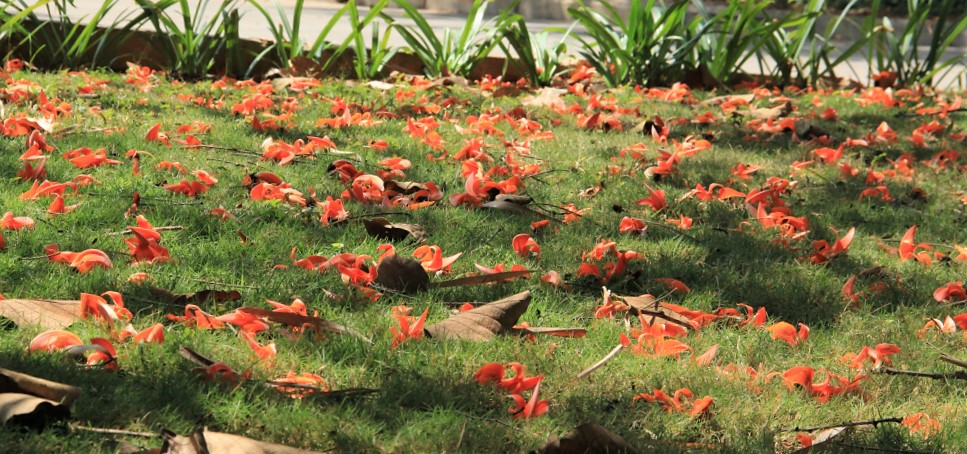
Driving through India’s dry deciduous forests during this season, across the Deccan (Telangana-Marathwada), the Western ghats of Sahyadris, Aravallis at NCR, Rajasthan and Gujarat, and gardens of Bangalore, an unmistakably common view of scarlet horizons. n bloom now, the forests and many urban gardens appear to be afire! The flowers of Palash and Spathodea splashing scarlet across the horizon…

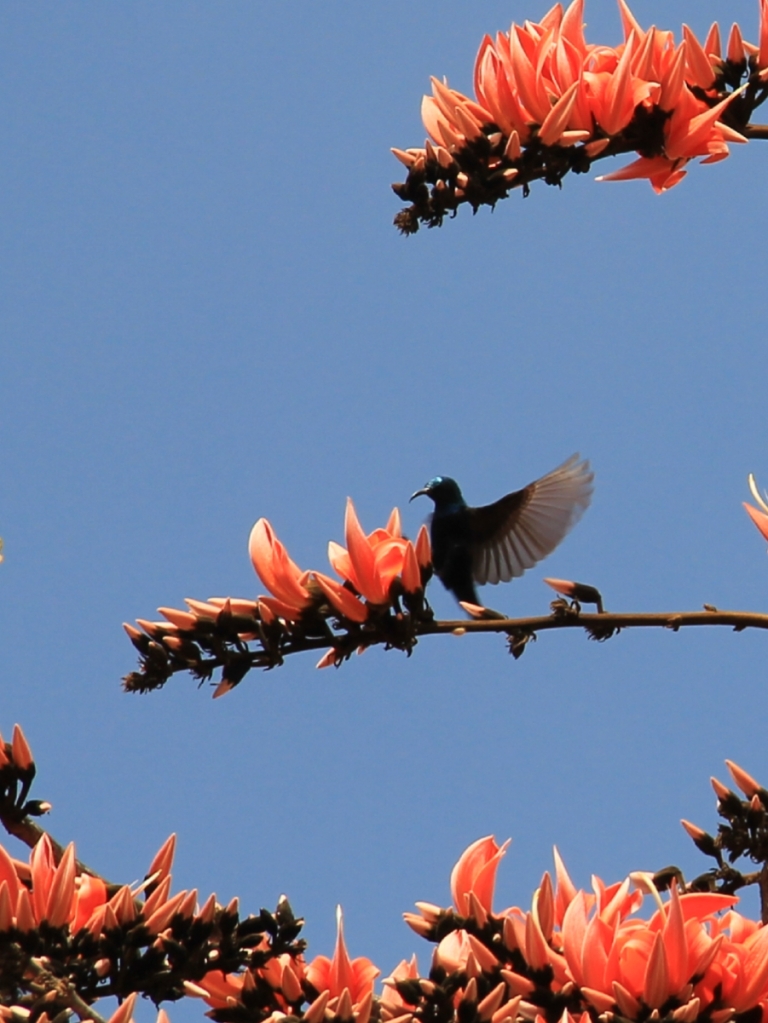
Here, a Purple Sunbird is about to take a sip off the flowers nectar; birds like this one and are the major pollinators of the Palash, including the Indian Rose-ringed Parakeets.

Vasant rtu starts shortly after Makara Sankranti, the harvest festival and the movement of Sun God into the zodiac sign of Capricorn. After the winter solstice in December, the days become longer, sun starts shining brighter and winter chill is on the wane. Hindu Gods are awake now in Uttarayan, and Vasant Panchami is celebrated heralding the official arrival of spring, across India.

Flame of the Forest, Tesu/Dhak (Hindi) Muttuga (Kannada), Moduga (Telugu) is the state flower of Jharkhand (literally meaning-an area of trees!) and Madhya Pradesh. Historically, Palash forests are said to cover much of the doab between the Ganga and Yamuna rivers, central and western India; these were cleared for farming in early 19th century, for East India Company’s increasing tax demands on the farmers. It’s variously used for timber, resin, medicine, and dye.

As Latin is common in Botany, its referred to in as frondosa (leafy) monosperma (single seed) and Butea, after John Stuart (3rd Earl of Bute, PM of Britain 1762-3), finally named Butea monosperma. Two other colours of this flower occur – white and cream-yellowish – which are quite uncommon.

The medium-sized (15m), fast growing, long living native Indian tree, needs little water, can tolerate drought, frost and saline soils; It has a greyish bark, crooked stem and irregular branches. The wood is white and soft, being water-durable used for well-curbs and water scoops and boats; produces good quality charcoal. Trifoliate (3-leaf-cluster, believed yo be the Holy Trinity), its large leathery leaves are unfit for fodder, but are put to good use as food plates and cups. Bengal Kino is a red-gum extruded from the tree (infested with lac-insect produces shellac) used in tanning leather and polishes, and as an astringent in pharma. Orange-colour obtained from flowers used to dye cotton fabric (of monks traditionally). Flowers are collected, soaked and the pale coloured water is used to play Holi in North India; now it is making a comeback as organic colour in powder form. Its wood is also used to make implements for sacrificial fires for initiating the fire itself. Leaves are also used to roll bidi.

Quite modest all year round, Jan~Mar is when it comes alive – in bright crimson! Sunbirds of all colours and sizes, Parrots, Mynas, Squirrels blearily running up and down the branches in gay intoxication, butterflies and bees buzzing around – pictures a whole ecosystem that’s thriving on the tree during this season! Trees like Palash, Semal, Coral tree, that rely mostly on birds for pollination are early in the flowering season, have large reddish flowers and mostly do not compete for attention; even if climate plays-up as in recent times, there’s so much in abundance that it hardly makes a difference. The trees that flower in purple, blue, yellow, pink and other colours follow and rely largely on insects like bees and butterflies for pollination, of course small birds.

Kimshuka (Sanskrit), means like a parrot, it is mentioned in various literary works and puranic legends, and as early as 4 BCE by Panini; many parts of the tree are used in vedic rituals and sacrificial fires and is considered sacred for Pointiffs. In Ayurveda, the tree is referred to as Brahmavrksha. The tree and its flower have numerous medicinal properties. For eg. Bathing in water boiled with the flowers can cure skins problems. Various parts are used for stomach ailments, The reddish-orange flowers are offered to Kali and to Shiva.

The tree is referred to as “Susravas”, meaning a tree with the best hearing ability. In Vedas it is mentioned, “DevAvai brahmannavadanta tatparna upAsruNot susravAvai namh”, meaning: A student should be able to grasp the teachings of the Guru in the Gurukula, just as the Palasa tree.

Palash is beneficial to ecology. It reduces about 75% of dust from one cubic litre of the atmosphere. It also acts as an air conditioner by liberating 10-20 litres of water per day per tree of average height through transpiration. A fully grown tree of 15+ yrs is a good carbon-sink and since it sheds leaves adds to biomass that enriches and balances the soil composition. It is also used to stabilize field bunds (said to hold water and so not cut-down)? and make saline soils suitable for other trees! Palash also can aspire 10~20 liters of water daily into the atmosphere, and so its environs are cool.

Tribal wealth: Tribals, the natives of India’s jungles place a lot of importance to nature, especially trees and water. in Jharkhand, Santhal and Sabar tribes value Palash immensely. Santhals make ropes of its fibrous back and roots and in making boats. In Manipur, a piece of wood is buried along with the dead, or if the body isn’t available, a log of the wood is buried/burnt! Tribal areas of Maharashtra and adjoining Chhattisgarh, value Palash as the best coolant, with nutritional and healing qualities; the tradition of consuming flower’s extract is forgotten, few older people still reminisce. During summer, cold infusion of the dried flower is consumed as sherbet, while a tea prepared with dried flower and leaves can be consumed all year long (beneficial for urinary and menstrual problems). Fresh leaves are placed on the head and secured to avoid sun-stroke.

Lakhs from Lac: Tribals in MP’s Shahdol dist were taught to harvest Lac from the Palash trees, which then grew in popularity and has revived as a popular farming practice. Historically, the princely state of Rewa, which gave refuge to Mughal king Akbar as a kid, was the first to establish India’s a Shellac factory, in 1903 by Raja Gulab Singh at Umaria in Shahdol district. Now, since its revival, Jharkhand and MP vie with eachother in its produce. India is the global leader in exporting Lac (used widely in wood polish, ornaments like bangles, ammunition, airplanes, perfumes and little toys). commercially, a kg of Lac costs Rs. 800, and yearly revenues rustle up to US$43.3 million in 2018-19! 90% of Lac resin is produced from Palash, Ber and Kusum trees, as well as blackseed grass.

‘Dhak ke teen paat’ in Hindi refers to its trifoliate (3) leaves cluster. A Marathi proverb translated means – one will not become poor as long as the tree is alive – referring to its immense value in native knowledge.

In literature: Many poets were inspired by the Palash, and referred to it as a symbol of love from Valmiki to Jayadev to Tagore; Chanakya, referred to beauty and lack of fragrance says:

रूपयौवनसम्पन्ना विशालकुलसम्भवाः। विद्याहीना न शोभन्ते निर्गन्धाः किंशुका यथा॥Though people be endowed with beauty and youth and born in noble families, yet without education they are like the Palas flower devoid of fragrance

Shantiniketan, where Gurudev Rabindranath Tagore spent a lot of his childhood, had a many flowering trees, so unsurprisingly, ~60 trees are mentioned in his poems; of them, Palash in ‘Ore Grihobashi’ written in 1931 exhorts people to enjoy the Spring season – an excerpt:

Ore grihobaasi! Khol, daar khol, laaglo je dol.Oh people! Open the doors! There is a spring stir!
Sthale jale banotale laaglo je dol!On soil, in water and the forests, there is a mad, spring stir!
Daar khol, daar khol!Open the doors!
Ranga haasi rashi rashi ashoke palaashe,A ruddy, laughter in abundance, amongst the ashok and palash flowers.
Ranga nesha meghe mesha probhato-aakashe, Nobino paatay laage ranga hillol.An intoxication amidst the clouds of the morning sky With new leaves leaving a bright splendor,
Daar khol, daar khol!Open the doors, open the doors!
The song is still played, during Vasanta-utsav, in Bangla regions, and esp Viswabharati Univ. established by Tagore.

Palashi is a village in east of West Bengal on the banks of Hooghly (Bhagirathi tributary) river, named due to a large grove of the Palash trees. The legendary Battle of Plassey (anglicized of Palashi) occurred near this village on June 23, 1757, where Nawab Siraj-ud-daulah lost to the treachery of Mir Jaffar and Robert Clive’s army of British East India Company – paving the way for their Empire and to rule India for the next 190 years.

Maharshi Valmiki in his epic, The Ramayana, Rama converses with Sita

AdIptAniva vaidehi sarvataH puShpitAnnagAn .

svaiH puShpaiH kiMshukAnpashya mAlinaH shishirAtyaye

O Sita, behold the Kimshuka trees, with their brilliant flowers blossoming all over as if they are blazing up this winter!

From setting fire to forests, to hearts, and to sacrificial havis, from resembling the blood of Rama, Lakshamana and Indrajit, to the soulless beauty dyeing saints’ clothes, to mirthful colours of holi, to parrots and poets, from medicines to pleasing the moon, Palash has appealed variously with intensity since time immemorial.

This brilliant tree must furrow back into our gardens, into the urban landscape, rather than being relegated to folklore.

undefined

Food – Hunger and Waste

There is enough food for everyone, but not everyone has enough food.

The world produces food to feed twice the current population; ironically, food waste causes billions of people to remain hungry and are malnourished. On average, about one-third of food produced globally is lost or wasted (UN-FAO). Every year on October 16, about 150 countries celebrate the World Food Day to mark founding of the Food and Agriculture Organization (FAO) of the United Nations in 1945, that’s that.

The second most populous country and second largest producer of food in the world – India – is home to 1/3rd of world’s hungry. By 2050, the population of India is estimated to reach 1.63 billion, overtaking the population of China. 34.5 % of the population is urban (471,828,295 people in 2019). The numbers are huge and therein lies a definite issue – the increasing need to scale up production, burgeoning consumption, waste, inequalities, hunger, and diminishing resources, destroyed natural habitats, geographical spread…

Food waste and loss amount to a reckless misspend of resources such as water, land, energy, labour and capital. UN estimates that 40 percent of the food produced (67 million metric tonnes) is either lost or wasted; 1.3 metric giga-tonnes of edible food is wasted worldwide per year.  This food wastage however, isn’t limited to one level alone but perforates through every stage; from harvesting, processing, packaging, and transporting to the end stage of consumption. Global food wastage accounts for 6.7% of greenhouse gas emissions.

The problem is, significant amount of food wastage occurs because of gaps in the logistics supply-chain (50% lesser cold storages in the nation to store fresh farm produce), and also due to excesses in consumption and unhindered disposal – which end-up in landfills or composted. GoI informed Parliament that over 11,889 tons of foodgrains were rotten at various centers of the Food Corporation of India FCI) in 2016-17. The estimated cost of this wastage is ~Rs 1 lakh crore.

34 out of 1,000 children born in the country die in the mother’s womb itself. 9 million children below the age of five die much before they can comprehend the meaning of independent India and ~200 million of our population sleep hungry on any given night. 3,000 children die of mal-nutrition everyday. But the problem is not just the food that’s wasted when leftovers go in the trash. It’s also all of the greenhouse gas emissions, water, biodiversity loss and soil & air pollution that was generated to create that food only for it to be tossed away unconsumed.

Wet-waste, kitchen waste, can be composted; but that wasn’t the purpose to cook food, right? Few statistics to put the waste problem into perspective:

  • 25% of fresh water used to produce food; equals to enough drinking water to 10 crore Indians p.a.
  • 300 million barrels of oil used to prepare cooked food.
  • 20% of all grocery and related purchases go into the waste
  • 21 million tonnes of wheat, 40% of fruits and vegetables, 30% of cereals go unused every year
  • 40% of cooked food (leftovers/excess cooked and plate-waste dumped into waste-bins
  • 15% of India’s population is under-nourished
  • 58% of all kids under 5 yrs are anaemic
  • 38% of kids under 5 yrs have stunted growth, which is 3% of global kid population
  • 21% of kids under 5 yrs are underweight and wasted (low weight to height ratio, debilitating muscle and fat tissue and hence a child is ‘wasted’)
  • 51% of women in the age-group of 15-49 are anaemic, resulting in 20% children born underweight
  • 20 crore Indians sleep hungry every day, of them, ~7,000 die of hunger
  • 830 million Indians survive on less than Rs. 20 per day
  • Hunger kills more people each year than AIDS, malaria and terrorism combined
  • 51 births occur each minute,  27 million per year.
  • 16.6 million added to the population per year.
  • 24 million children in the country are orphans, of which only 0.3% do not have both parents.

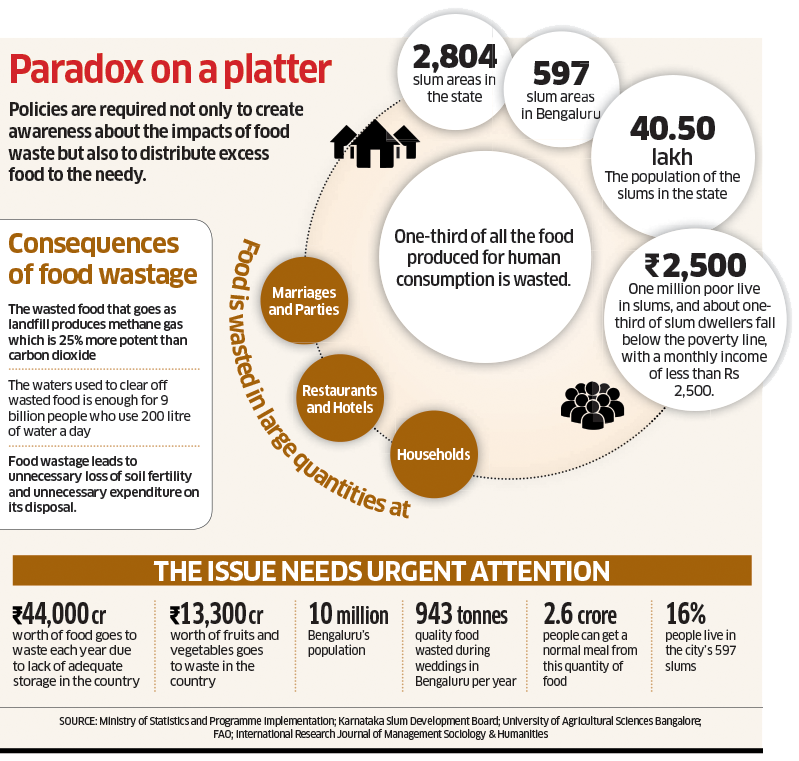
A team of 10 professors from the University of Agricultural Sciences (UAS), Bangalore, surveyed 75 of Bangalore’s wedding halls over six months; they recorded a wastage a whopping 943 tonnes of good quality food, enough to feed 2.6 crore people a regular Indian meal.

Feeding a Nation

Access to food is a challenge that GoI is tackling at its own pace. National Food Security Act (NFSA), 2013 provides for coverage of upto 75% of the rural population and upto 50% of the urban population, thus covering about two-third of the population of the country for receiving foodgrains @ of Rs. 3, 2 & 1 per Kg for rice, wheat & coarse grains respectively under TPDS.

  • The Indian Government on its part is fast-tracking enhancement of storage facilities across India to safeguard foodgrains.
  • Improving the PDS system to ensure that ~90% of Indian families in both urban and rural areas can have access to procuring essentials.
  • Contemporary research has confirmed the crucial importance of nutrition in the first 1,000 days of a child’s life. The nutrition provided in the period between conception and the child’s second birthday is critical for its optimum cognitive and physical development. Breastfed infants are more likely to have better physical and mental health, well into adulthood. ICDS or Integrated Child Development Services is setup to tackle the malnutrition malaise.
  • India’s mid-day meal scheme is the world’s largest Govt sponsored mass feeding program, with a budgetary allocation of 11,000 crores during 2019-20. This scheme covers 9.12 crore children of 11.35 lakh schools, 8.45 lakh kitchens, employing 25.95 lakh people from marginalized communities. This is aside to private organisations at various states covering ~50 lakh children.
  • The PM, sensing the problems of scale, had expressed concern about the population explosion, in his Independence Day speech of 2019; he even said – that those who follow policy of small family contributes to the development of the nation.

Minimizing edible food waste: Did you know – by segregating, recycling and composting, a family of 4 can reduce their waste generation from 1,000kgs to less than 100 kg every year?  Now, multiply this statistics with 1.3 billion population and imagine the result! Adopt a zero-waste-lifestyle – Buy less, cook as much is required, take lesser portions than you think you can eat and refill plate if necessary later. If you are left with cooked food, that isn’t stale, or anticipate excess leftovers at your event, please do seek out areas where underprivileged people live and share it with them; do not leave it to the caterer or event manager to ‘manage’ the waste. If you know of a hotel where food waste is an issue, connect them to an organisation who willingly takes away the edible food and distribute to the needy. a short list of organisations is below, and there could be many more local heroes who do this out of passion.

  • Feeding India               9871178810    www.feedingindia.org (pan India)
  • Robinhood Army                                 www.robinhoodarmy.com (pan India)
  • Lets Feed Bangalore                            www.letsfeedblr.com (Bangalore, fresh food only)
  • No food waste             9087790877    www.nofoodwaste.in (Tamilnadu)
  • Manav Charities          080-28386828 www.manavcharities.org (Bangalore)
  • Sumanahalli Society  9481085727    www.sumanahalli.net (Bangalore)
  • Feedthehungry           8971530638    Raghunandan, Bangalore.

List of organisations on IFSA (India Food Safety Alliance) Network – (20 States, 99 Cities, 4 Union territories), refer: https://sharefood.fssai.gov.in/agency-list.html

  • Sources researched for this article –
  • Pib.nic.in
  • Data.gov.in
  • Rchiips.org/nfhs/NFHS-4Reports/India
  • National Family and Health Survey 2015-16, Dec 2017
  • Mhrd.gov.in
  • Bhookh.com
  • Indiaspend.com
  • Indiafoodbanking.com
  • Indiaenvironmentalportal.org.in
  • sharefood.fssai.gov.in/
  • thebetterindia.com
Food Waste Graphic

Ideal Village, Khadi and Swaraj

Gandhiji had deep insights and plans to bring about a positive change to Bharat as it existed during his time; he had indeed spelt out the framework with which to achieve true Swaraj, or self-rule, and empowerment to India and its citizens. India, an traditional agrarian economy, adept in the skill of the hand and passed down knowledge for generations earlier, was to transform into a cohesive nation, a global economy growing on its deep rooted wisdom, by learning new tricks of trade and above all, inclusive societal development, without barriers. In his magazine the Harijan he write about how an Ideal Village could take shape and dovetail the growth, but also laments about what could have been and how to be redeemed.

An ideal Indian village will be so constructed as to lend itself to perfect sanitation. It will have cottages with sufficient light and ventilation built of a material obtainable within a radius of five miles of it. The cottages will have courtyards enabling householders to plant vegetables for domestic use and to house their cattle. The village lanes and streets will be free of all avoidable dust. It will have wells according to its needs and accessible to all. It will have houses of worship for all, also a common meeting place, a village common for grazing its cattle, a co-operative dairy, primary and secondary schools in which industrial education will be the central fact, and it will have Panchayats for settling disputes. It will produce its own grains, vegetables and fruit, and its own Khadi. This is roughly my idea of a model village…I am convinced that the villagers can, under intelligent guidance, double the village income as distinguished from individual income. There are in our villages in­exhaustible resources not for commercial purposes in every case but certainly for local purposes in almost every case. The greatest tragedy is the hopeless un­willingness of the villagers to better their lot.

My ideal village will contain intelligent human beings. They will not live in dirt and darkness as animals. Men and women will be free and able to hold their own against anyone in the world. There will be neither plague, nor cholera, nor smallpox; no one will be idle, no one will wallow in luxury. Everyone will have to contribute his quota of manual labour…. It is possible to envisage railways, post and telegraph…and the like…

Khadi and Spinning

Khadi to me is the symbol of unity of Indian humanity, of its economic freedom and equality and, therefore, ultimately in the poetic expression of Jawaharlal Nehru, ‘the livery of India’s freedom’.
Moreover, Khadi mentality means decentralization of the production and distribution of the necessaries of life. Therefore, the formula so far evolved is, every village to produce all its necessaries and a certain percentage in addition for the requirements of the cities.

Production of Khadi includes cotton growing, picking, ginning, cleaning, carding, slivering, spinning, sizing, dyeing, preparing the warp and the woof, weaving, and washing. These, with the exception of dyeing, are essential processes. Every one of them can be effectively handled in the villages and is being so handled in many villages throughout India which the A. I. S. A. (All India Spinners Association) is covering. Imagine the unifying and educative effect of the whole nation simultaneously taking part in the processes up to spinning! Consider the levelling effect of the bond of common labour between the rich and the poor!

The message of the spinning wheel is much wider than its circumference. Its message is one of simplicity, service of mankind, living so as not to hurt others, creating an indissoluble bond between the rich and the poor, capital and labour, the prince and the peasant.

I stand by what is implied in the phrase, ‘unto this last’. We must do even unto this last as we would have the world do by us. All must have equal opportunity. Given the opportunity, every human being has the same possibility for spiritual growth. That is what the spinning wheel symbolizes.

The disease of the masses is not want of money so much as it is want of work. Labour is money. He, who provides dignified labour for the millions in their cottages, provides food and clothing, or which is the same thing, money. The Charkha provides such labour. Till a better substitute is found, it must, therefore, hold the field. Idleness is the great cause, the root of all evil, and if that root can be destroyed, most of the evils can be remedied without further effort. A nation that is starving has little hope or initiative left in it. It becomes indifferent to filth and disease. It says of all reforms, ‘to what good?’ That winter of despair can only be turned into the ‘sun-shine of hope’ for the millions only through the life-giving wheel, the Charkha.

The spinning wheel is an attempt to produce something out of nothing. If we save sixty crores of rupees to the nation through the spinning wheel, as we certainly can, we add that vast amount to the national income. In the process we automatically organize our villages.

It is my claim that (by reviving Khadi and other village industries) we shall have evolved so far that we shall remodel national life in keeping with the ideal of simplicity and domesticity implanted in the bosom of the masses. We will not then be dragged into an imperialism which is built upon exploitation of the weaker races of the earth, and the acceptance of a giddy materialistic civilization protected by naval and air forces that have made peaceful living almost impossible. When once we have revived the one industry (Khadi), all the other industries will follow. I would make the spinning wheel the foundation on which to build a sound village life; I would make the wheel the centre round which all other activities will revolve.

The ideal of Khadi has always been as a means, par excellence, for the resuscitation of villages and therethrough the generation of real strength among the masses—the strength that will ipso facto bring Swaraj.

Our work had a very humble beginning. When I started Khadi I had with me, apart from Maganlalbhai and others who had elected to live and die with me, Vitthaldasbhai and a few sisters. We have travelled a long way since then and today about two crores of people have come under the influence of the Charkha. By its help we have been able to provide the village people with a large amount of money. But can we still hold, as we have always maintained, that Swaraj is impossible without the Charkha? So long as we do not substantiate this claim the Charkha is really no more than a measure of relief, to which we turn because we can do nothing else about it. It would not then be the means of our salvation.

Secondly, we have failed to carry our message to the crores of our people. They have neither any knowledge of what the Charkha can do for them nor even the necessary curiosity for it.”

Well, I am no Gandhian, nor a scholar with deep insights into his thoughts. I feel, the great man was both practical and futuristic at the same time and that is his greatness, to be relevant even after a hundred-odd-years. We as a nation have failed as followers of the Mahatma. It is very easy to be dismissive and become pessimistic, given the state of the affairs today. But, there is still scope for espousing the cause, rekindling the dream of Swaraj and bring about a positive change in the society. It is not for the government/s to drive the change, but we, as patriotic individuals have the power and the responsibility to re-ignite the nationalism in our own homes, little community silos, starting in simple ways, which could dovetail and spread to the society, state, and the nation. Notes to follow will dwell on such thoughts.

Comments are most welcome. Dialogues enhance knowledge.

– Excerpts from Gandhiji’s writings in Harijan, Young India, 1926~42; mkgandhi.org