
There is enough food for everyone, but not everyone has enough food.
The world produces food to feed twice the current population; ironically, food waste causes billions of people to remain hungry and are malnourished. On average, about one-third of food produced globally is lost or wasted (UN-FAO). Every year on October 16, about 150 countries celebrate the World Food Day to mark founding of the Food and Agriculture Organization (FAO) of the United Nations in 1945, that’s that.
The second most populous country and second largest producer of food in the world – India – is home to 1/3rd of world’s hungry. By 2050, the population of India is estimated to reach 1.63 billion, overtaking the population of China. 34.5 % of the population is urban (471,828,295 people in 2019). The numbers are huge and therein lies a definite issue – the increasing need to scale up production, burgeoning consumption, waste, inequalities, hunger, and diminishing resources, destroyed natural habitats, geographical spread…
Food waste and loss amount to a reckless misspend of resources such as water, land, energy, labour and capital. UN estimates that 40 percent of the food produced (67 million metric tonnes) is either lost or wasted; 1.3 metric giga-tonnes of edible food is wasted worldwide per year. This food wastage however, isn’t limited to one level alone but perforates through every stage; from harvesting, processing, packaging, and transporting to the end stage of consumption. Global food wastage accounts for 6.7% of greenhouse gas emissions.
The problem is, significant amount of food wastage occurs because of gaps in the logistics supply-chain (50% lesser cold storages in the nation to store fresh farm produce), and also due to excesses in consumption and unhindered disposal – which end-up in landfills or composted. GoI informed Parliament that over 11,889 tons of foodgrains were rotten at various centers of the Food Corporation of India FCI) in 2016-17. The estimated cost of this wastage is ~Rs 1 lakh crore.
34 out of 1,000 children born in the country die in the mother’s womb itself. 9 million children below the age of five die much before they can comprehend the meaning of independent India and ~200 million of our population sleep hungry on any given night. 3,000 children die of mal-nutrition everyday. But the problem is not just the food that’s wasted when leftovers go in the trash. It’s also all of the greenhouse gas emissions, water, biodiversity loss and soil & air pollution that was generated to create that food only for it to be tossed away unconsumed.
Wet-waste, kitchen waste, can be composted; but that wasn’t the purpose to cook food, right? Few statistics to put the waste problem into perspective:
- 25% of fresh water used to produce food; equals to enough drinking water to 10 crore Indians p.a.
- 300 million barrels of oil used to prepare cooked food.
- 20% of all grocery and related purchases go into the waste
- 21 million tonnes of wheat, 40% of fruits and vegetables, 30% of cereals go unused every year
- 40% of cooked food (leftovers/excess cooked and plate-waste dumped into waste-bins
- 15% of India’s population is under-nourished
- 58% of all kids under 5 yrs are anaemic
- 38% of kids under 5 yrs have stunted growth, which is 3% of global kid population
- 21% of kids under 5 yrs are underweight and wasted (low weight to height ratio, debilitating muscle and fat tissue and hence a child is ‘wasted’)
- 51% of women in the age-group of 15-49 are anaemic, resulting in 20% children born underweight
- 20 crore Indians sleep hungry every day, of them, ~7,000 die of hunger
- 830 million Indians survive on less than Rs. 20 per day
- Hunger kills more people each year than AIDS, malaria and terrorism combined
- 51 births occur each minute, 27 million per year.
- 16.6 million added to the population per year.
- 24 million children in the country are orphans, of which only 0.3% do not have both parents.
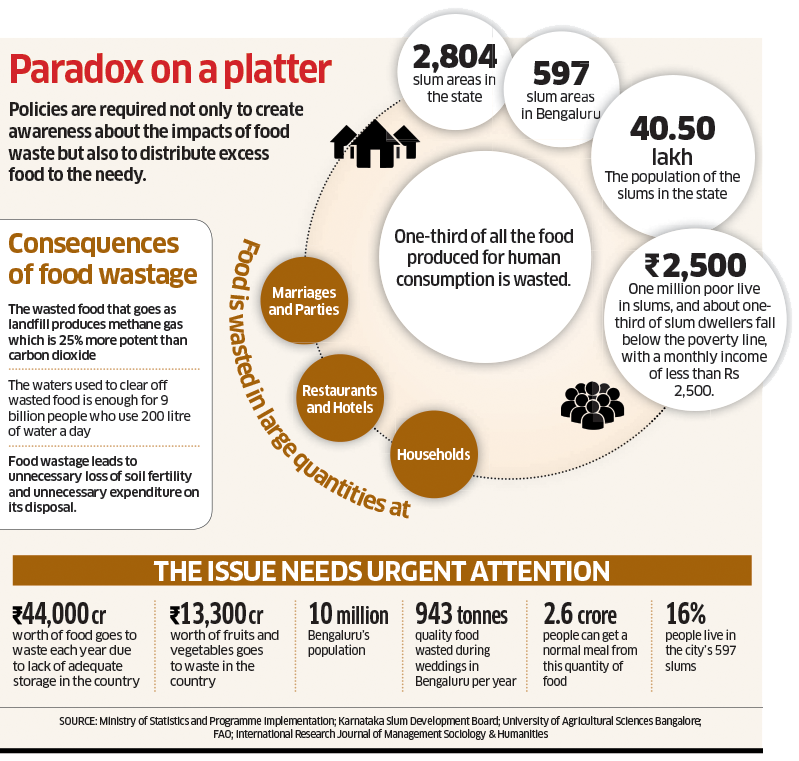
A team of 10 professors from the University of Agricultural Sciences (UAS), Bangalore, surveyed 75 of Bangalore’s wedding halls over six months; they recorded a wastage a whopping 943 tonnes of good quality food, enough to feed 2.6 crore people a regular Indian meal.
Feeding a Nation
Access to food is a challenge that GoI is tackling at its own pace. National Food Security Act (NFSA), 2013 provides for coverage of upto 75% of the rural population and upto 50% of the urban population, thus covering about two-third of the population of the country for receiving foodgrains @ of Rs. 3, 2 & 1 per Kg for rice, wheat & coarse grains respectively under TPDS.
- The Indian Government on its part is fast-tracking enhancement of storage facilities across India to safeguard foodgrains.
- Improving the PDS system to ensure that ~90% of Indian families in both urban and rural areas can have access to procuring essentials.
- Contemporary research has confirmed the crucial importance of nutrition in the first 1,000 days of a child’s life. The nutrition provided in the period between conception and the child’s second birthday is critical for its optimum cognitive and physical development. Breastfed infants are more likely to have better physical and mental health, well into adulthood. ICDS or Integrated Child Development Services is setup to tackle the malnutrition malaise.
- India’s mid-day meal scheme is the world’s largest Govt sponsored mass feeding program, with a budgetary allocation of 11,000 crores during 2019-20. This scheme covers 9.12 crore children of 11.35 lakh schools, 8.45 lakh kitchens, employing 25.95 lakh people from marginalized communities. This is aside to private organisations at various states covering ~50 lakh children.
- The PM, sensing the problems of scale, had expressed concern about the population explosion, in his Independence Day speech of 2019; he even said – that those who follow policy of small family contributes to the development of the nation.
Minimizing edible food waste: Did you know – by segregating, recycling and composting, a family of 4 can reduce their waste generation from 1,000kgs to less than 100 kg every year? Now, multiply this statistics with 1.3 billion population and imagine the result! Adopt a zero-waste-lifestyle – Buy less, cook as much is required, take lesser portions than you think you can eat and refill plate if necessary later. If you are left with cooked food, that isn’t stale, or anticipate excess leftovers at your event, please do seek out areas where underprivileged people live and share it with them; do not leave it to the caterer or event manager to ‘manage’ the waste. If you know of a hotel where food waste is an issue, connect them to an organisation who willingly takes away the edible food and distribute to the needy. a short list of organisations is below, and there could be many more local heroes who do this out of passion.
- Feeding India 9871178810 www.feedingindia.org (pan India)
- Robinhood Army www.robinhoodarmy.com (pan India)
- Lets Feed Bangalore www.letsfeedblr.com (Bangalore, fresh food only)
- No food waste 9087790877 www.nofoodwaste.in (Tamilnadu)
- Manav Charities 080-28386828 www.manavcharities.org (Bangalore)
- Sumanahalli Society 9481085727 www.sumanahalli.net (Bangalore)
- Feedthehungry 8971530638 Raghunandan, Bangalore.
List of organisations on IFSA (India Food Safety Alliance) Network – (20 States, 99 Cities, 4 Union territories), refer: https://sharefood.fssai.gov.in/agency-list.html
- Sources researched for this article –
- Pib.nic.in
- Data.gov.in
- Rchiips.org/nfhs/NFHS-4Reports/India
- National Family and Health Survey 2015-16, Dec 2017
- Mhrd.gov.in
- Bhookh.com
- Indiaspend.com
- Indiafoodbanking.com
- Indiaenvironmentalportal.org.in
- sharefood.fssai.gov.in/
- thebetterindia.com

 Wise | OtherWise