Colour, but Naturally

Holi is the festival of colours and shared joy. The spring festival symbolizes

Widely celebrated in the North, over the years it has gained a pan-Indian’s fervor.  Young and old, men and women participate equally with gusto.  Who can forget shaking a leg to dholak beats and phagun folk songs, or dancing with gay abandon to popular cinema songs, squirting coloured water at each other with water-guns…. There was the odd person/kid who would hide, runaway terrified of getting coloured only to be chased down – some would join with a bit of cajoling, few locked themselves shut.

While kids continue fun’n’frolic, elders would sneak away to delightful helpings of bhang-spiked or plain laddoos, gujia, thandai or lassi. Gradually, Bhang became rarer being officially banned, and alcohol took over the festivities. Bhang is a mixture of dried-ground leaves and buds of Cannabis sativa; technically therapeutic in small quantities, addictive in long term consumption – leading to hysterical paranoia and depression. 

Colours became synthetic and nobody realized or even cared as long as it was cheap and easily available – all through 80’s and 90’s, when even metallic paints like silver were used – and their effects went largely unreported. It was a recent drive – a decade ago helped by the internet revolution, that the harmful effects of chemicals came to light and awareness of organic colours grew (used since time immemorial – well at least from the start of mythologies about Holika and Prahlad, festivities during the time of Rama and Krishna, etc.)

Below is a list of colours made naturally, at home, using commonly available flowers, vegetables, flour; I have also highlighted the chemicals that are avoided and their effects on humans.

ColourDry useWet useChemicals avoided
RedShade dried red hibiscus flowers /  Red sandalwood powder, mixed with flour of rice/chickpea (1:1)Red-sandalwood powder mixed in water; Diluted limestone powder (chuna-100 gms in 10 ltrs) mix with 100 gms turmeric – dilute and useMercury sulphite – skin cancer, renal failure, nervous disorders, impaired vision,
Yellow / Saffronmix (1:2) turmeric + chickpea flour Dried marigold, yellow chrysanthemums, cosmos; A mix of sandalwood powder and rice flour (1:2) for pale yellow.Boiled pomegranate peels Boiled or soaked pomegranate peels for pale yellow, add turmeric for deep shade; strain, dilute, use. A pinch of saffron if affordable; Raw turmeric root, shredded and soaked overnight, dilutedLead oxide – irritability, skin and vision disorders, brain damage, poisoning
GreenDried Henna leaves, green leafy veg like spinach, dry amla powder Dried neem/methi/mint/coriander leaves – powder, mix with rice flour/besanSoaked henna leaves overnight; paste of pudina / spinach, neem – mix with water and use; Grind wheat-grass diluted in water for light greenCopper sulphate – eye irritation & swelling, temporary blindness
Magenta / PinkShade dried rose petals, crushed; Gomphrena , mix with rice flourSliced Beetroot boiled and cooled Soak Kokum rind overnight, strain, dilute, use. (one beet = 5 ltrs colour; 100 gms kokum = 1 ltr colour)Chromium iodide – bronchial asthma, respiratory ailments  
Purple Boil red/purple cabbage leaves – strain, dilute, use.Chromium iodide; Gentian Violet – dermatitis, eye keratoconjunctivitis
BlueDried blue hibiscus and jacaranda flowers, shade dried, powdered, mixed with besan;Crushed Jacaranda/Shankh pushp / peaflower   flowers, soaked overnight / boiledPrussian blue – Dermatitis, Skin irritation, eye allergies
Yellow / OrangeDried Palash flowers, powdered, mix with besan/chickpea flour Mix turmerix with besan (1:2)Palash soaked overnight / boiled Boiled yellow chrysanthemum Boiled onion skin Boil Orange and lemon peels for light yellow / ochre shadesAuramine & Chromium Iodide – bronchial asthma, respiratory ailments
BrownMix mehendi leaf powder and amla powder, dilute with besanKaththa (Acacia catechu) powder (used in paan)Chromium iodide – respiratory issues
Dark brown / blackMix of all above colours! Dried amla powder, mix with besanSoaked gooseberry overnight in an iron vessel; strain, dilute, use Boil few tea/coffee-leaves (one table spoon = 2 ltrs colour), strain, dilute, use. Boiled / overnight soaked henna leaves Charcoal soaked overnight, strain, useLead oxide – nervous damage, renal failure, mental disability

In addition to the chemicals listed against each colour, there are harmful substances like Nickel, Cadmium, Zinc, Iron, , mica, asbestos, gypsum, silica. Remember – using chemical and metallic colours is like taking a shower with  the contents of an alkaline battery! While we love to enjoy, we also have the responsibility to safeguard ourselves, our families and the environment from toxins.

Colour me naturally

This list is just indicative of natural colours; there are many Grandma’s recipes for homemade colours; but should all this delightful process of making your own colours is too much of work and a quick purchase of colours  is unavoidable, there are various options now to buy naturally made colours, some listed below:

Petalists: Their colours are made by recycling flowers collected from Temples and Wedding halls, by mixing with other non-toxic ingredients mentioned earlier. The flowers used to make the colours give them a natural and mild fragrance as also a soft texture. These are dry colours which being very easy to clean,  are skin-friendly and suitable for people of all ages, including kids.

These colours are carefully packaged using zero plastic, making it totally pro-environment. Significantly, it generates livelihood for over 200 persons with intellectual disability, offering them a dignified source of income (Patients of Nimhans in Bangalore, undergoing psychiatric treatment, whom I have personally visited and seen their laborious colour making process). more on this visit shortly.

Phool is another organization that collects flowers from temples of Varanasi to make fragrances and Gulaal.

Others: eCoexist’s Rang Dular | Redearth India’s Swarang | Greenpractices, but of course, online portals like Amazon have many brands.

Notes to Colour

  • Call them by any name – organic, natural, herbal, floral, satvic, traditional, eco-friendly, earth-sensitive, etc. they must be made of naturally grown items. These natural colours are safe for the skin, hair, eyes, and even if ingested by mistake, they do not cause any harm.
  • Natural colours require less than 1/3rd of water required to remove chemical / commercially available colours.
  • Use of rice flour and chickpea flour is better than using maida, starch or talc, as the powders are heavy, with less dust that reduces absorption by lungs. Sandalwood powder adds aroma to Blue, Brown, Purple,
  • For Dry powder colours just dust off, before rinsing. For wet colours, if skin stains, they will wear-out with a bath or two.
  • Whether you use dry/wet colours, clothes will stain – be aware. Wash them quick enough so as to reuse/recycle.
  • In this era of water shortage, and conserving water is necessary, it is best to avoid wet colours, or water hosing.
  • Use of dried flowers is the best! But since we are used to the  habit of showing off dyed clothes and stained skin, colours become necessary.
  • The camaraderie, community celebrations, the feeling of ‘playful togetherness’ and ‘shared joy’ is more important than amount of colour used, it doesn’t harm to be frugal. Let’s not buy tonnes and get bored.

No to Colours

  • Among the big no-no’s, other than synthetic colours and wasting water are – water-balloons, metallic-colours (gold, silver).  These ultimately pollute our rivers and oceans!
  • A no means no! If one doesn’t enjoy getting coloured, please let them be – sport needs spectators too to cheer!
  • For those who are not the colour-filled kind, find a place to plant a tree that gives beautiful colourful flowers – or gift a packet of colours to a poor kid – spread the cheer!!

No plastic! Refuse to use plastics and disposables (incl tetrapaks, paper cups, juice/water bottles, plastic pichhkaris), tissues, food-waste and recycle bottles if used..

While on the topic of being earth friendly, there are delightful recipes for natural juices

  • Palash based – a cool juice from dried flowers, infused with saunf and sweetened with jaggery! add crushed mint leaves for additional flavour.
  • Saunf based – which doesn’t require any hard word, except soaking the required quantity overnight and to add a zing to this drink, a dash of soda will do perk it up!
  • Cucumber based – ground cucumber juice diluted in water, with a hint of jaggery is a surefire cooler on a warm spring afternoon!

Enjoy the  Splash of  Colours, Sensibly!

Holi Hai!!  होली है!

respect nature | conserve water | plant trees

E-lectric and a lot of Cloud

India’s thirst for EVs (Electric Vehicles) received a major push in India’s Union Budget of 2019-20, and is expected to improve further in the budget of 2020-21 and thenceforth.

In March 2019, India’s union cabinet approved setting up of a National Mission on Transformative Mobility and Battery Storage, to drive clean, connected, shared, sustainable and holistic mobility initiatives. The proposed capacity target for lithium-ion battery-manufacturing base has been raised to 50GW from 40GW. The government is in the process of tendering for set up of 50GW battery manufacturing base at around US$50 billion investment.

While this is good news, there is total ignorance among majority of general public.

“At Mahindra AGM our shareholders asked us when are we getting into EVs. If after producing and selling EVs for 9 yrs, after having 5,000 eCars on the Indian roads, after 135 M eMiles behind us if our share holders don’t know that we make EVs, we have failed in our communication,” said Dr Pawan Goenka, the head of Mahindra, a day after the recent AGM in Mumbai. Mahindra have the most diversified indigenous range of e-auto products in India currently – the sedan E-verito, e-Supro minivan and E2O+ Hatch as also 3-Ws Treo and e-Alfa mini. Mahindra is setting up an advanced Lithium-ion battery plant along with the Korean LG Chem at Chakan near Pune – half-a-million modules per year.

Indian rules say that assembling cells within the geography of the country is enough to quality under Make-in-India. This means, the cells are imported – largely from Taiwan and China, and doesn’t have the competence to manufacture the cells itself. The recent COVID-19 situation and resultant lockdown in China has led to severe shortages of various types of rawmaterial used in a wide variety of industries, including EVs – prompting Mahindra to state that BSVI roll-out would be delayed, while mobile companies said they could shut for at least a 10 days – if things don’t improve at China and components supply is hampered further.

In an already weak manufacturing situation (Auto sales down ~40% in 2019-20), this is the last thing that industries had expected / wanted. But viruses have a mind of their own, and our minds are clouded. This was an opportunity for Indian industries to step-up and grab their share of the global market. Well, elephants seldom dance, let alone fly, and panic when in stress; Elephants are cute and majestic, though!

A lithium-ion battery accounts for 40% of the total cost of an EV. Toshiba-Denso-Suzuki JV has invested in a 1,100 cr lant in Gujarat for Li-ion batteries. Panasonic plans to step into this field as well. an EV battery manufacturing set-up could cost ~200 crores, which only deep pockets can afford. While collaboration could mitigate the technology development costs, everyone prefers to climb the wall to discover the struggle for themselves. Mahindra on its part is willing to find synergies with Tata Motors.

EVs must fire-up before losing charge

The recent Auto Expo 2020 at Noida in Feb, threw up 18 EV startups and their wares – autos, mopeds, bikes, scooters and a Bus. Of all, only one was Arai certified, the rest being concepts. AutoExpo 2019 had 11 startups, but majority of them haven’t seen significant growth nor have captured the market.

Large Auto companies – Mahindra, Tata motors, Maruti and Volkswagen too displayed their current options and concepts; remains to be seen how these get accepted by the public. In the period Apr-Dec 2019, only 1,554 4W EVs were sold! A host of launches were made by Kia, Tata and Hyundai, and their marketability remains to be seen, in the tepid waters. The fate of EVs from BMW, Mercedes is anybody’s guess. An improvement in the EV market was the jump in sales – 2017: 56,000 EVs, 2018-19: 759,000 EVs – mostly in 2W and 3W. The crux is – individual 4W-EVs sales is not forging ahead as anticipated and the current numbers are largely of call-rider companies purchases. Experts believe that current crop of 4W-EVs are at best a second car, and the first time buyer or first choice of car still will continue to be powered by fossil-fuel. How many can afford a Tesla Electric in the world?

Hero Electric (11 2W-EV models!) is gingerly testing waters; Bajaj went retro and announced an Electric version of the legendary Chetak (remember Buland Bharat ki Buland Tasveer? but how Hamara will this Bajaj be, with Rajiv hating the e-word). Elsewhere in the globe, Sony built a Vision-S car; so why not our own Micromax build a Revolt bike? Should big boys have all the e-fun?! Yulu is a flimsy moped, but it is in shared rides cocoon with limited mobility, I was petrified riding one for 300-mtrs at a stretch. Then there are the Okinawa, Battre, Ultraviolette, Tork… all e-attempting. There is a star, though, in Ather, powered by ex-Flipkart’s Bansals, Tiger Global and Hero Motocorp, which seems to be leading in the 2-W market for now, and intends to invest Rs 635 crores for a manufacturing plant at Hosur, which will double their current capacity of 40,000 2-W-EVs pa., and have reportedly invested in putting-up 40 public charge stations in Bangalore and Chennai.

Given the cost of charging infrastructure, Govt needs to step in to bolster this critical public infra countrywide (2,346 charging stations in 24 states is a slow start), if it is serious about 2030 deadline (hope it doesn’t peter out like the recent Plastics Ban fiasco!). At present, at SMEV there are 28 EV manufacturing companies in their fold while the rest of the total 72 members are into components alone. https://www.smev.in/smev-members. Can a startup rise to manufacture charging stations in India? An exuberant elephant calf, perhaps?

How green is my power? If fossil fuels are responsible for increase of CO2 in the atmosphere, Coal is a co-culprit with 40% contribution. Besides, when burnt, coal produces pollutants like sulfurdioxide, mercury, and particulate matter which result in acid-rain and damage the environment. Not to mention serious ecological damage done to the forests due to mining and transport. In India, 62.80% is generated by thermal plants, Hydro and Nuclear provide 12 and 2% respectively, while Renewable power is a healthy 23%.

Alternate energy: When we talk of energy sources like Hydel, Solar, Wind and Nuclear energy, they seem to be the best solution. But are they? It is laudable that UN sees India leading the global thrust, but it still doesn’t feature in the list of top 10 countries that are ready to transition into a secure, sustainable, reliable, and affordable alternate energy future. According to WEF, 81% of global energy systems is still dependent on fossil fuels and so is India. Solar panels have a life of say, 25 years, with diminishing performance and degrading of panels; then what? What to do with these panels… manufacturers like Tata Solar, Vikram, Emvee, have no clue, yet. US and Europe are in planning stages with pilots running. Though the panel (made of glass, silicon, plastic and aluminium) is recyclable, it is difficult to extract the web of metals to reuse, and could end up in landfills; but then – where is so much of land? Wind Farms are falling out of favour – with erratic wind patterns, poor generation and transmission losses, maintenance glitches, high initial infra cost coupled with mounting financial burden, not to mention damage to sensitive eco-system in remote areas (dizzy wild animals, dying bees, et al). EV’s batteries are made largely of Lithum which is again a mined RE metal with limited resources worldwide.

Clear Policies: Indian Govt specifically needs to focus on reducing imported parts for EVs if the local industry (already reeling on slackened auto market) has to find their mojo once again. Incentivising home-production and increasing duty on imported CBUs, parts and components, will be a good start – given that EVs require ~800 lesser auto-components than conventional ones (a survey in Germany found out and that it could also mean a million-job-loss). Increasing common charging points in public spaces, a specific policy for end of life battery cases and solar panels that cannot be recycled must be put in place forthwith, or else we will be filling the Earth with more toxins and rare-earth substances in an effort to save fossil fuels!

Alternate Green energy: ET Energy quotes TERI in a recent article, that India’s 18 sq km surface area of reservoirs has the potential to generate 280 GW of solar power, using floatovoltaics; this report was tabled at the recent World Sustainable Development Summit 2020; given the high costs of land acquisition this seems to be an alternate to generating green-energy. China, Japan and South Korea are said to be leaders of this floating-power-generation technology, while UK has the world’s largest farm. Floating Solar Farms, of 50 MW to shortly take-off in Kerala by National Hydro Power Corpn; but before rushing to establish this unique tech, must consider possible ecological damage to the biodiversity and aquatic life. In a study of one such farm by Kyocera TCL Solar LLC at the Yamakura Dam reservoir in Japan found reduction in algal blooms reduced evaporation of water, and the blocking of UV rays, while being difficult to maintain and prone to damage, but on the plus side, the panels generated more power being cooled by the waters below.

All in all, a holistic approach is necessary to:

  1. Conserve Fossil fuels, reduce dependency
  2. Limit environment pollution, preserve natural resources, restore ecology
  3. Devise concrete plans for alternate energy sources
  4. Clear road-map for Electric vehicles and public e-Charging infra
  5. Wean away from external dependence for parts and components
  6. Allow for healthy co-existence of conventional and EVs
  7. Promote clean affordable energy
  8. Policies for recycling end-of-life products

Views are own; info from various sources including domestic and international Media, MNRE, Govts, UN, UNEP, WEF

Poems, Parrots and Palash

Truly, nature ‘spring’s to life in all its glory – a riot of colours, a heady blend of fragrances, chirping of birds, humming of bees, frolicking butterflies… Gurudev couldn’t be wrong, it is truly intoxicating!

Ektuku choya lage, ektuku kothai shuni

Tayee diye mone mone rochi mamo phaalguni.

Kichchu palasher nesha, kichu ba chapaye mesha

Tayee deeye shure shure range rashe jaal buni

A light touch do I feel, a few words do I hear

And I conjure in my mind spring’s full moon

The intoxicating red of ‘palash’, blend with fragrance of champa

I weave with music into a net of colour and fervour

 – Rabindranath Tagore *

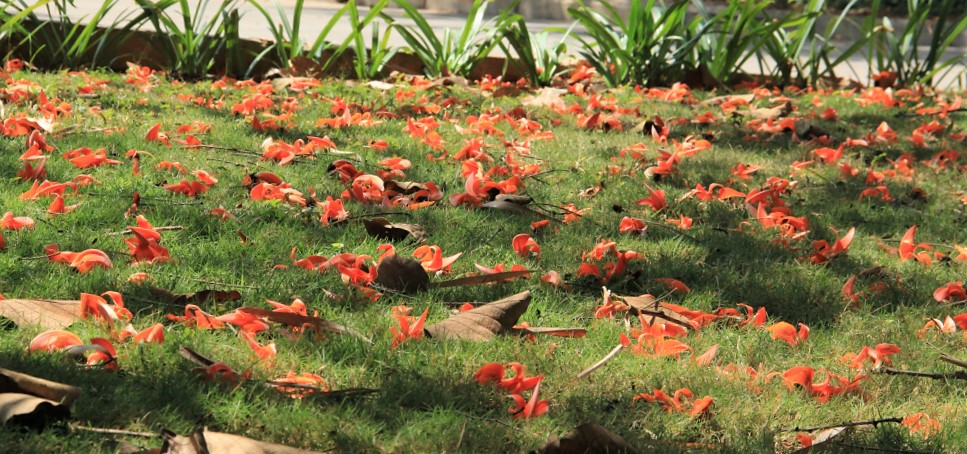
Driving through India’s dry deciduous forests during this season, across the Deccan (Telangana-Marathwada), the Western ghats of Sahyadris, Aravallis at NCR, Rajasthan and Gujarat, and gardens of Bangalore, an unmistakably common view of scarlet horizons. n bloom now, the forests and many urban gardens appear to be afire! The flowers of Palash and Spathodea splashing scarlet across the horizon…

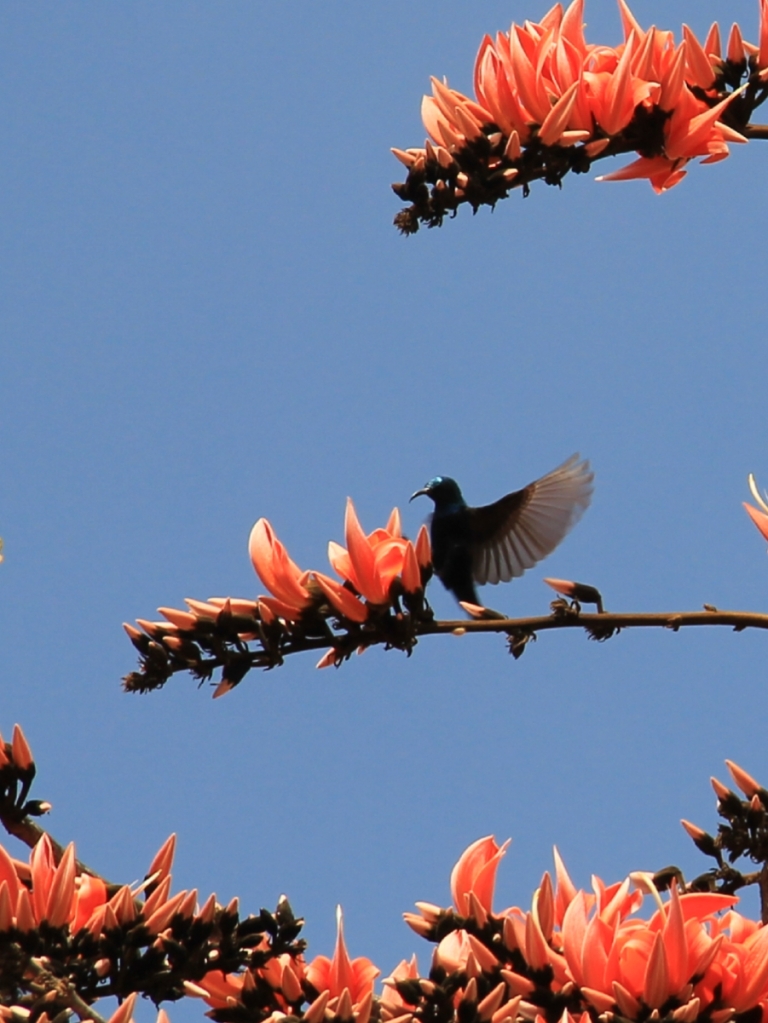
Here, a Purple Sunbird is about to take a sip off the flowers nectar; birds like this one and are the major pollinators of the Palash, including the Indian Rose-ringed Parakeets.

Vasant rtu starts shortly after Makara Sankranti, the harvest festival and the movement of Sun God into the zodiac sign of Capricorn. After the winter solstice in December, the days become longer, sun starts shining brighter and winter chill is on the wane. Hindu Gods are awake now in Uttarayan, and Vasant Panchami is celebrated heralding the official arrival of spring, across India.

Flame of the Forest, Tesu/Dhak (Hindi) Muttuga (Kannada), Moduga (Telugu) is the state flower of Jharkhand (literally meaning-an area of trees!) and Madhya Pradesh. Historically, Palash forests are said to cover much of the doab between the Ganga and Yamuna rivers, central and western India; these were cleared for farming in early 19th century, for East India Company’s increasing tax demands on the farmers. It’s variously used for timber, resin, medicine, and dye.

As Latin is common in Botany, its referred to in as frondosa (leafy) monosperma (single seed) and Butea, after John Stuart (3rd Earl of Bute, PM of Britain 1762-3), finally named Butea monosperma. Two other colours of this flower occur – white and cream-yellowish – which are quite uncommon.

The medium-sized (15m), fast growing, long living native Indian tree, needs little water, can tolerate drought, frost and saline soils; It has a greyish bark, crooked stem and irregular branches. The wood is white and soft, being water-durable used for well-curbs and water scoops and boats; produces good quality charcoal. Trifoliate (3-leaf-cluster, believed yo be the Holy Trinity), its large leathery leaves are unfit for fodder, but are put to good use as food plates and cups. Bengal Kino is a red-gum extruded from the tree (infested with lac-insect produces shellac) used in tanning leather and polishes, and as an astringent in pharma. Orange-colour obtained from flowers used to dye cotton fabric (of monks traditionally). Flowers are collected, soaked and the pale coloured water is used to play Holi in North India; now it is making a comeback as organic colour in powder form. Its wood is also used to make implements for sacrificial fires for initiating the fire itself. Leaves are also used to roll bidi.

Quite modest all year round, Jan~Mar is when it comes alive – in bright crimson! Sunbirds of all colours and sizes, Parrots, Mynas, Squirrels blearily running up and down the branches in gay intoxication, butterflies and bees buzzing around – pictures a whole ecosystem that’s thriving on the tree during this season! Trees like Palash, Semal, Coral tree, that rely mostly on birds for pollination are early in the flowering season, have large reddish flowers and mostly do not compete for attention; even if climate plays-up as in recent times, there’s so much in abundance that it hardly makes a difference. The trees that flower in purple, blue, yellow, pink and other colours follow and rely largely on insects like bees and butterflies for pollination, of course small birds.

Kimshuka (Sanskrit), means like a parrot, it is mentioned in various literary works and puranic legends, and as early as 4 BCE by Panini; many parts of the tree are used in vedic rituals and sacrificial fires and is considered sacred for Pointiffs. In Ayurveda, the tree is referred to as Brahmavrksha. The tree and its flower have numerous medicinal properties. For eg. Bathing in water boiled with the flowers can cure skins problems. Various parts are used for stomach ailments, The reddish-orange flowers are offered to Kali and to Shiva.

The tree is referred to as “Susravas”, meaning a tree with the best hearing ability. In Vedas it is mentioned, “DevAvai brahmannavadanta tatparna upAsruNot susravAvai namh”, meaning: A student should be able to grasp the teachings of the Guru in the Gurukula, just as the Palasa tree.

Palash is beneficial to ecology. It reduces about 75% of dust from one cubic litre of the atmosphere. It also acts as an air conditioner by liberating 10-20 litres of water per day per tree of average height through transpiration. A fully grown tree of 15+ yrs is a good carbon-sink and since it sheds leaves adds to biomass that enriches and balances the soil composition. It is also used to stabilize field bunds (said to hold water and so not cut-down)? and make saline soils suitable for other trees! Palash also can aspire 10~20 liters of water daily into the atmosphere, and so its environs are cool.

Tribal wealth: Tribals, the natives of India’s jungles place a lot of importance to nature, especially trees and water. in Jharkhand, Santhal and Sabar tribes value Palash immensely. Santhals make ropes of its fibrous back and roots and in making boats. In Manipur, a piece of wood is buried along with the dead, or if the body isn’t available, a log of the wood is buried/burnt! Tribal areas of Maharashtra and adjoining Chhattisgarh, value Palash as the best coolant, with nutritional and healing qualities; the tradition of consuming flower’s extract is forgotten, few older people still reminisce. During summer, cold infusion of the dried flower is consumed as sherbet, while a tea prepared with dried flower and leaves can be consumed all year long (beneficial for urinary and menstrual problems). Fresh leaves are placed on the head and secured to avoid sun-stroke.

Lakhs from Lac: Tribals in MP’s Shahdol dist were taught to harvest Lac from the Palash trees, which then grew in popularity and has revived as a popular farming practice. Historically, the princely state of Rewa, which gave refuge to Mughal king Akbar as a kid, was the first to establish India’s a Shellac factory, in 1903 by Raja Gulab Singh at Umaria in Shahdol district. Now, since its revival, Jharkhand and MP vie with eachother in its produce. India is the global leader in exporting Lac (used widely in wood polish, ornaments like bangles, ammunition, airplanes, perfumes and little toys). commercially, a kg of Lac costs Rs. 800, and yearly revenues rustle up to US$43.3 million in 2018-19! 90% of Lac resin is produced from Palash, Ber and Kusum trees, as well as blackseed grass.

‘Dhak ke teen paat’ in Hindi refers to its trifoliate (3) leaves cluster. A Marathi proverb translated means – one will not become poor as long as the tree is alive – referring to its immense value in native knowledge.

In literature: Many poets were inspired by the Palash, and referred to it as a symbol of love from Valmiki to Jayadev to Tagore; Chanakya, referred to beauty and lack of fragrance says:

रूपयौवनसम्पन्ना विशालकुलसम्भवाः। विद्याहीना न शोभन्ते निर्गन्धाः किंशुका यथा॥Though people be endowed with beauty and youth and born in noble families, yet without education they are like the Palas flower devoid of fragrance

Shantiniketan, where Gurudev Rabindranath Tagore spent a lot of his childhood, had a many flowering trees, so unsurprisingly, ~60 trees are mentioned in his poems; of them, Palash in ‘Ore Grihobashi’ written in 1931 exhorts people to enjoy the Spring season – an excerpt:

Ore grihobaasi! Khol, daar khol, laaglo je dol.Oh people! Open the doors! There is a spring stir!
Sthale jale banotale laaglo je dol!On soil, in water and the forests, there is a mad, spring stir!
Daar khol, daar khol!Open the doors!
Ranga haasi rashi rashi ashoke palaashe,A ruddy, laughter in abundance, amongst the ashok and palash flowers.
Ranga nesha meghe mesha probhato-aakashe, Nobino paatay laage ranga hillol.An intoxication amidst the clouds of the morning sky With new leaves leaving a bright splendor,
Daar khol, daar khol!Open the doors, open the doors!
The song is still played, during Vasanta-utsav, in Bangla regions, and esp Viswabharati Univ. established by Tagore.

Palashi is a village in east of West Bengal on the banks of Hooghly (Bhagirathi tributary) river, named due to a large grove of the Palash trees. The legendary Battle of Plassey (anglicized of Palashi) occurred near this village on June 23, 1757, where Nawab Siraj-ud-daulah lost to the treachery of Mir Jaffar and Robert Clive’s army of British East India Company – paving the way for their Empire and to rule India for the next 190 years.

Maharshi Valmiki in his epic, The Ramayana, Rama converses with Sita

AdIptAniva vaidehi sarvataH puShpitAnnagAn .

svaiH puShpaiH kiMshukAnpashya mAlinaH shishirAtyaye

O Sita, behold the Kimshuka trees, with their brilliant flowers blossoming all over as if they are blazing up this winter!

From setting fire to forests, to hearts, and to sacrificial havis, from resembling the blood of Rama, Lakshamana and Indrajit, to the soulless beauty dyeing saints’ clothes, to mirthful colours of holi, to parrots and poets, from medicines to pleasing the moon, Palash has appealed variously with intensity since time immemorial.

This brilliant tree must furrow back into our gardens, into the urban landscape, rather than being relegated to folklore.

undefined

Blue Moon

The Great Oriental Eggfly – Hypolimnas bolina jacinta

Hypolimnas bolina is a common butterfly, found across the world (Australasia, Indo-Malay) in woody areas; not surprisingly, they are all over India as well – July to December are best for sighting these bright little garden treats. They belong to the same brush-footed species of butterflies, like the Monarch.

The specimen featured here is a male – with two large white spots with a hint of iridescent blue/violet. Flying low or gliding, or honey-sucking or resting on a leaf – they are a treat to watch. Intensely territorial (specially the males) they can be seen chasing away other species of b-flies. The females with brownish wings and small white spots on its fringes, take great care to ensure that she lays eggs on a plant that doesn’t have ants!

The male great eggfly is so territorial, that they may even fly closer to / charge at larger mammals and even humans – all this in a lifespan of 24 days. Favourite host plants include creeping foxglove (Asystasia gangetica).

Bolina, in Greek mythology was a nymph that falls in love with Apollo, but dies of drowning when she leaves him… whereas the origins of hypolimnas is unknown. The species was identified and described in 1738 by Linnaeus.

Food – Hunger and Waste

There is enough food for everyone, but not everyone has enough food.

The world produces food to feed twice the current population; ironically, food waste causes billions of people to remain hungry and are malnourished. On average, about one-third of food produced globally is lost or wasted (UN-FAO). Every year on October 16, about 150 countries celebrate the World Food Day to mark founding of the Food and Agriculture Organization (FAO) of the United Nations in 1945, that’s that.

The second most populous country and second largest producer of food in the world – India – is home to 1/3rd of world’s hungry. By 2050, the population of India is estimated to reach 1.63 billion, overtaking the population of China. 34.5 % of the population is urban (471,828,295 people in 2019). The numbers are huge and therein lies a definite issue – the increasing need to scale up production, burgeoning consumption, waste, inequalities, hunger, and diminishing resources, destroyed natural habitats, geographical spread…

Food waste and loss amount to a reckless misspend of resources such as water, land, energy, labour and capital. UN estimates that 40 percent of the food produced (67 million metric tonnes) is either lost or wasted; 1.3 metric giga-tonnes of edible food is wasted worldwide per year.  This food wastage however, isn’t limited to one level alone but perforates through every stage; from harvesting, processing, packaging, and transporting to the end stage of consumption. Global food wastage accounts for 6.7% of greenhouse gas emissions.

The problem is, significant amount of food wastage occurs because of gaps in the logistics supply-chain (50% lesser cold storages in the nation to store fresh farm produce), and also due to excesses in consumption and unhindered disposal – which end-up in landfills or composted. GoI informed Parliament that over 11,889 tons of foodgrains were rotten at various centers of the Food Corporation of India FCI) in 2016-17. The estimated cost of this wastage is ~Rs 1 lakh crore.

34 out of 1,000 children born in the country die in the mother’s womb itself. 9 million children below the age of five die much before they can comprehend the meaning of independent India and ~200 million of our population sleep hungry on any given night. 3,000 children die of mal-nutrition everyday. But the problem is not just the food that’s wasted when leftovers go in the trash. It’s also all of the greenhouse gas emissions, water, biodiversity loss and soil & air pollution that was generated to create that food only for it to be tossed away unconsumed.

Wet-waste, kitchen waste, can be composted; but that wasn’t the purpose to cook food, right? Few statistics to put the waste problem into perspective:

  • 25% of fresh water used to produce food; equals to enough drinking water to 10 crore Indians p.a.
  • 300 million barrels of oil used to prepare cooked food.
  • 20% of all grocery and related purchases go into the waste
  • 21 million tonnes of wheat, 40% of fruits and vegetables, 30% of cereals go unused every year
  • 40% of cooked food (leftovers/excess cooked and plate-waste dumped into waste-bins
  • 15% of India’s population is under-nourished
  • 58% of all kids under 5 yrs are anaemic
  • 38% of kids under 5 yrs have stunted growth, which is 3% of global kid population
  • 21% of kids under 5 yrs are underweight and wasted (low weight to height ratio, debilitating muscle and fat tissue and hence a child is ‘wasted’)
  • 51% of women in the age-group of 15-49 are anaemic, resulting in 20% children born underweight
  • 20 crore Indians sleep hungry every day, of them, ~7,000 die of hunger
  • 830 million Indians survive on less than Rs. 20 per day
  • Hunger kills more people each year than AIDS, malaria and terrorism combined
  • 51 births occur each minute,  27 million per year.
  • 16.6 million added to the population per year.
  • 24 million children in the country are orphans, of which only 0.3% do not have both parents.

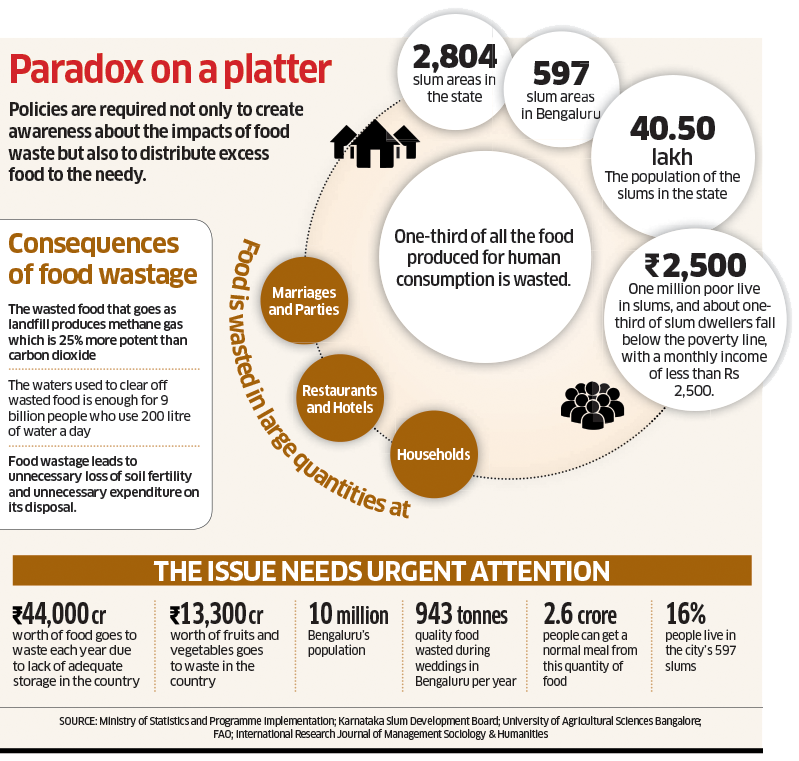
A team of 10 professors from the University of Agricultural Sciences (UAS), Bangalore, surveyed 75 of Bangalore’s wedding halls over six months; they recorded a wastage a whopping 943 tonnes of good quality food, enough to feed 2.6 crore people a regular Indian meal.

Feeding a Nation

Access to food is a challenge that GoI is tackling at its own pace. National Food Security Act (NFSA), 2013 provides for coverage of upto 75% of the rural population and upto 50% of the urban population, thus covering about two-third of the population of the country for receiving foodgrains @ of Rs. 3, 2 & 1 per Kg for rice, wheat & coarse grains respectively under TPDS.

  • The Indian Government on its part is fast-tracking enhancement of storage facilities across India to safeguard foodgrains.
  • Improving the PDS system to ensure that ~90% of Indian families in both urban and rural areas can have access to procuring essentials.
  • Contemporary research has confirmed the crucial importance of nutrition in the first 1,000 days of a child’s life. The nutrition provided in the period between conception and the child’s second birthday is critical for its optimum cognitive and physical development. Breastfed infants are more likely to have better physical and mental health, well into adulthood. ICDS or Integrated Child Development Services is setup to tackle the malnutrition malaise.
  • India’s mid-day meal scheme is the world’s largest Govt sponsored mass feeding program, with a budgetary allocation of 11,000 crores during 2019-20. This scheme covers 9.12 crore children of 11.35 lakh schools, 8.45 lakh kitchens, employing 25.95 lakh people from marginalized communities. This is aside to private organisations at various states covering ~50 lakh children.
  • The PM, sensing the problems of scale, had expressed concern about the population explosion, in his Independence Day speech of 2019; he even said – that those who follow policy of small family contributes to the development of the nation.

Minimizing edible food waste: Did you know – by segregating, recycling and composting, a family of 4 can reduce their waste generation from 1,000kgs to less than 100 kg every year?  Now, multiply this statistics with 1.3 billion population and imagine the result! Adopt a zero-waste-lifestyle – Buy less, cook as much is required, take lesser portions than you think you can eat and refill plate if necessary later. If you are left with cooked food, that isn’t stale, or anticipate excess leftovers at your event, please do seek out areas where underprivileged people live and share it with them; do not leave it to the caterer or event manager to ‘manage’ the waste. If you know of a hotel where food waste is an issue, connect them to an organisation who willingly takes away the edible food and distribute to the needy. a short list of organisations is below, and there could be many more local heroes who do this out of passion.

  • Feeding India               9871178810    www.feedingindia.org (pan India)
  • Robinhood Army                                 www.robinhoodarmy.com (pan India)
  • Lets Feed Bangalore                            www.letsfeedblr.com (Bangalore, fresh food only)
  • No food waste             9087790877    www.nofoodwaste.in (Tamilnadu)
  • Manav Charities          080-28386828 www.manavcharities.org (Bangalore)
  • Sumanahalli Society  9481085727    www.sumanahalli.net (Bangalore)
  • Feedthehungry           8971530638    Raghunandan, Bangalore.

List of organisations on IFSA (India Food Safety Alliance) Network – (20 States, 99 Cities, 4 Union territories), refer: https://sharefood.fssai.gov.in/agency-list.html

  • Sources researched for this article –
  • Pib.nic.in
  • Data.gov.in
  • Rchiips.org/nfhs/NFHS-4Reports/India
  • National Family and Health Survey 2015-16, Dec 2017
  • Mhrd.gov.in
  • Bhookh.com
  • Indiaspend.com
  • Indiafoodbanking.com
  • Indiaenvironmentalportal.org.in
  • sharefood.fssai.gov.in/
  • thebetterindia.com
Food Waste Graphic

Trees and Us

That trees feel and express is being realised, world over. That nature speaks, in its own language, is also a fact, least acknowledged.

I have experienced, time and again, visions and voices, murmurs and groans, smiles and laughter, and sighs of despair. As you walk along, as you say hello to friends, acquaintances, strangers, and to the nature around; you would be surprised that, nature, actually, talks back! The connect wasn’t just with nature I lived with for decades, sometimes you just stroll in a park, a forest or a manicured landscaped garden, and hear voices, vibrations that can be comprehended in peace.

Voices? Vibrations? …some might just think of a learned shrink’s advise.

Trees grow all over the place, breaking pavements and walls, damaging roads, breaking into homes and just destroying; the same species growing elsewhere grow accommodating things around them, hardly raising a brick, perfectly in peace with its surroundings; while one lives happily even surrounded by concrete, a neighbour in a lush garden just wilts, dies.

Friendly neighbours

What makes them to behave (yes behave) differently? Remember kids? how they grow to be rowdy or statesmanly or just a normal everyday person? Commonly we know, its about the climate, environment, ground, soil, manure, water, insects, bees, butterflies, and all that; its also about training, care and most importantly, love. If you care enough, a dead tree comes alive, or a happy tree can simply wither away. They also teach us – about growth, positivity, efficiency, resource management, co-habitation, adapting to change, handling dangers, face in the sun and tiding over seasons, and absolute Life in general.

As I was gathering my thoughts and putting pen to paper (colloquially…), I came across this post, that surmised all that and much more. Reproduced here with permission from Cordele Glass the author, is an article from positivepsychologynews.com

WHAT TREES CAN TEACH US ABOUT DEVELOPMENT

People rarely acknowledge the fact that trees are living beings that eat, reproduce, and react to their environment. Trees have been around for over 390,000,000 years and all of that time has imbued them with an irrefutable wisdom regarding how to live life. The differences between humans and trees are vast, but that does not imply that every bit of a tree’s wisdom can be disregarded as irrelevant. Below are some lessons I’ve gleaned about life and development from some of the wisest teachers I know.

Sometimes Change is a Good Thing

Deciduous trees lose their leaves when they decide the environment calls for a different approach to life and their way of being. This is the change many people associate with red and yellow autumn leaves. It happens gradually yet fully; without hesitation, uncertainty, or regret. They rely on a combination of genetic and environmental factors to help them know when the time for change is right.

Turning leaves

Living with the knowledge that change is an inevitable and vital aspect of our development is what helps us to continue advancing in ways that guide our bodies and our surroundings toward harmony. Many developmental psychologists take a lifespan view of development. This lifespan perspective is supported by work in neuroscience with concepts like plasticity suggesting that neural and psychological change continues to take place long after adulthood has begun. Neuroscientist Michael Merzenich has a Ted Talk explaining some of the basic tenets of neural plasticity. Impermanence or perpetual change is also a foundational idea in Buddhist psychology and various other Vedantic teachings tied to acceptance, peace, and spiritual development.

As We Grow, We Transcend and Include

Dendrochronology is the scientific study of trees and how they develop over time. As they grow, each layer continues to contribute to the whole life and being of the tree. The older, smaller parts add to the fullness of the individual tree, and yet there is more that makes up the tree as it continues to interact with the environment, changing over time. The new rings do not reject, diminish, judge, or demean the older parts of the tree. Instead, they include them, they surround them, and they work in harmony to contribute to the whole tree’s life.

Transcend and include

As our consciousness develops we begin to take wider and wider perspectives. We begin in infancy by only considering our immediate needs of food and warmth, emotional and physical safety. As we learn and our perspectives grow we begin to consider the needs of others including our parents and our closest friends. Through adolescence, wider social circles become more important to our values, actions, and interests. As social and emotional development continues we begin to include communities, cultures, and nations into our considerations and priorities. Generally speaking, humans tend to move from egocentric to ethnocentric to world-centric as we transcend, yet include, each stage of growing up. Each subsequent stage fully includes the prior stage.

This theory of transcending and including stages of consciousness is known as Spiral Dynamics. It was first put forth by Dr. Clare Graves (a contemporary of Abraham Maslow) and later popularized by the work of Don Beck, Christopher Cowan, and Ken Wilbur. Spiral Dynamics synthesizes the gamut of psychology’s best developmental theories into a model of holarchical stages that stretch across the human lifespan and the human species itself. In philosophy, a holon is something that is simultaneously a whole and a part.

Some Parts of Life Need Energy and Some Parts Don’t

Living tree, some dead branches

As trees grow older, taller, and wiser they often reallocate their resources to leaves and branches that contribute the most to their life, and away from the branches and leaves that are no longer catching light. The unused branches and leaves eventually wither and fall off the tree as the higher branches and leaves flourish and continue to contribute to the tree’s development.

We live in the same world as trees, and in this world, there is a limited amount of energy we can use at one time. Putting this energy into the parts of our lives that help us to thrive and develop is vital to an engaging and meaningful life. Since energy is limited, reallocating energy toward these things may mean that other parts of life, whether they be friends, family, jobs, hobbies, or environments, may have to wither and occasionally be removed all together. Dr. Bonnie Benard calls this process Adaptive Distancing and lauds it as a significant contributor to the development of resilience in children and adolescents. This shedding, reorienting, or diminishing is in service of putting the most energy possible into the friends, family, jobs, hobbies, or environments that contribute the most to our lives.

Being Open to as Much Light as Possible Leads to the Most Growth

Trees try to maximize the surface area of their leaves because they need light to grow. Sometimes they use massive individual leaves like the Bigleaf Maple Tree, sometimes they go for quantity like the needles of a Conifer Tree, and sometimes they reach high above the competition like the Coastal Redwoods.

Growing toward the light

Many trees grow their branches toward more concentrated areas of light and some plants even move with the sun as it travels across the sky, a process called heliotropic sun-tracking. They know how important light is, and they try their best to openly receive as much as possible.

Finding light in our own human lives is just as vital to our growth. For us, it may come from the kind words of a new friend, the passion felt from an inspiring action in others, or the comfort felt from connecting with our bodies. It may be the awe of a mountain view, the thrill of a favorite sport, or the touch of a loved one. The field of Positive Psychology has dedicated itself to researching these aspects of human psychological light with the above examples supported by hundreds of rigorous studies from around the world. Barbara Fredrickson has demonstrated that our psychological resources can broaden and build with the light of positive emotions. Deci and Ryan have posited that the light of relatedness is a psychological necessity, and Mihaly Csikszentmihalyi has investigated thoroughly how the light of flow states helps to grow our psychological complexity. We too can approach life by being as open and receptive as possible to the things that give us light that helps us grow.

Summary

Trees let go of flowers…

Trees can teach us to embrace change. They can also teach us that with change we needn’t discard aspects of our past, but rather we can keep them and use them to stay strong as we transcend our current states. Attending to the things we need for growth and being as open to our needs as possible can set us up for continued success. We can act in ways that allow people, feelings, and experiences to fill us up and contribute to life and development of well-being. We can do this without trying to hold onto them forever and without expecting them to be a certain way. Just like trees.

The original article can be read at: https://positivepsychologynews.com/news/cordele-glass/2018091239189

Ikigai – Reason to Live, Happily

This dwells on self-improvement, and sheds new light on an age old theory – To find life’s purpose and reason is key to being happy.

Success Mantra

This Japanese secret to a longer and happier life is gaining attention around the world. In Japan, the secret to living a longer, happier and more fulfilled life can be summed up in one word: Ikigai.

In Japanese, iki means “to live” and gai means “reason” — in other words, your reason to live. This ideology dates to the Heian period (A.D. 794 to 1185), but only in the past decade has it gained attention from millions around the world.

The ikigai way of life is especially prominent Okinawa, in a group of islands south of mainland Japan. (It has also been nicknamed the “Land of Immortals” because it has among the longest lifespans and highest rates of centenarians in the world.)

‘The reason for which you wake up in the morning’

In a 2009 TED talk called  “How to Live to Be 100+,” award-winning journalist Dan Buettner explores the lifestyle traits of five places in the world where people live the longest. Of all the  “blue zones,” as Buettner defines them, Okinawans have the highest life expectancy. (The video has since been viewed close to four million times.)

“In America, we divide our adult life into two categories: Our work life and our retirement life,” he says. “In Okinawa, there isn’t even a word for retirement. Instead there’s simply ‘ikigai,’ which essentially means ‘the reason for which you wake up in the morning.’”

Buettner cites the ikigai of several Okinawans: For a 101-year-old fisherman, it was catching fish for his family three times a week; for a 102-year-old woman, it was holding her tiny great-great-great-granddaughter (which she said was “like leaping into heaven”); for a 102-year-old karate master, it was teaching martial arts. Woven together, these simple life values give clues as to what constitutes the very essence of ikigai: A sense of purpose, meaning and motivation in life.

The health benefits of ikigai

For years, researchers have tried to find the reasons behind a long and healthy life. While the answer is likely a mix of good genes, diet and exercise, studies have suggested that finding meaning in life is also a key component.

In a 2008 study from Tohoku University, researchers analyzed data from more than 50,000 participants (ages 40 to 79) and found that those who reported having ikigai in their lives had reduced risks of cardiovascular diseases and lower mortality rates. Put another way, 95% of respondents who had ikigai were still alive seven years after the initial survey compared to the 83% who didn’t.

It’s impossible to tell whether ikigai guarantees longevity in life through this single study, but the findings suggest that having a sense of purpose can encourage one to build a happy and active life.

Finding your inner ikigai

There’s no single way to find your ikigai, but you can start by asking a few simple questions: What makes you happy? What are you good at? What (and who) do you value? What motivates you to get up in the morning?

Finding your ikigai will take time. The secret, I often tell people, is to learn the five core pillars of ikigai (which I discuss in my book, “Awakening Your Ikigai”). By applying these pillars to your life, you can allow your inner ikigai to flourish.

1. Starting small – Starting small and executing every step with care is the very ethos of this pillar — and it applies to everything you do in life. Artisanal farmers, for example, devote all their time and effort into creating the best and tastiest produce. They get the soil right. They prune and water their produce with care. Their sense of starting small propels them to go incredible lengths.

2. Releasing yourself – When you release yourself, you’re able to let go of your obsessions and see things that matter to you in a more clear and positive light. Practicing self-acceptance is vital to this pillar — and yet, it’s also one of the most difficult tasks we face in our lives. But if you can overcome this obstacle and be happy with who you are, it can be an incredibly rewarding experience.

3. Harmony and sustainability – You can’t achieve your goals if you’re constantly fighting with the people around you. Cultivating — and maintaining — a sense of community will provide you with a strong support system to carry you through life’s most challenging moments.

4. The joy of small things – Finding joy in the small things — the morning air, a cup of coffee or the ray of sunshine — should be part of what motivates you to get up each morning. In high school, I would take the same 6:20 a.m. train to class every day. The sight the same familiar faces enjoying a game of shogi (Japanese chess) always gave me immense joy.

5. Being in the here and now – This pillar is perhaps the most profound. To be in the here and now, it’s important to focus on the present and practice mindfulness every day. Many sumo wrestlers testify that being in the here and now is absolutely necessary in preparing for and fighting in a bout. They claim that immersing themselves in the present helps sustain their state of mind for optimum performance.

Other inferences that can be drawn from the concept of Ikigai is to be passionate about what you do, even if it may seem insignificant; have a purpose or even several purposes; and celebrate little things.

Ken Mogi is a neuroscientist, best-selling author and lecturer based in Tokyo, Japan. He has published more than 30 papers on cognitive neuroscience. Awakening your Ikigai is his first book in English

Blue Mormon – The Stately

Butterflies are the candies of nature. They not only appear beautiful, but also help the ecology – by pollinating flowers and ensuring continuity to the nature’s cycle.

The butterfly featured here is Blue Mormon, Papilio polymnestor. A large swallowtail butterfly (wing-span of 12~14 cms) commonly found in South of India and Sri Lanka. (Australasia / IndoMalaya ecozone). They are recorded as pollinators of Cardamom (Elettaria cardamomum).

Blue Mormons, the second largest and commonly sighted butterfly in India occur through the year, most prolific after rains during Sept~Nov. These butterflies – with rich velvety black wings, large light blue / white hindwings with spots – are found in gardens, landscapes and orchards with Citrus and Murraya trees – most common in heavy rainfall areas such as rainforests; also found woody urban spaces due to availability Larval host plants. Flowers like Ixora, Jasmine, Foxglove and Indian atlantia are a few favourites. They fly rapidly in unidirection hopping and changing course abruptly.

Blue Mormon is the State Butterfly of Maharashtra – the first such butterfly to be accorded such status, and the first state in India to declare one such, on June 22, 2015.

Blue Mormon – Papilio polymnestor

Female mormons have a light red stripe near its neck, the only differentiator between the genders. These are one of the butterflies known for mud-puddling (suck nutrients out of mud/soil). It was identified in 1775 by Cramer.

Eat Right

One thing that has gained on popularity in the past couple of years other than climate change, is – Millets, a staple crop of hot, arid, semi-arid, sub-humid areas for humans and animals as well. It is the 5th most produced cereal in the world. Millet is the name given to a group of cereals other than wheat, rice, maize & barley.

Millets are rich in minerals, vitamins, and packed with dietary source of nutrients. Every other doctor, nutritionists, news articles, health magazines scream of its goodness and suggest recipes to the millennials. Exclusive millet serving restaurants have mushroomed across Metro cities

Millet, the wonder grain: They are said to be anti-acidic and gluten-free and fibre-rich, help prevent type-2 diabetes, breast cancer, aids in weight loss, reducing blood pressure and risk of gastro-intestinal problems like gastric ulcers/colon cancer, celiac disease, aids sleep y reducing stress, slows muscle degeneration, protects the heart, detoxify body, eliminates problems like constipation, excess gas, bloating and cramping, its antioxidants are anti-ageing, aids breast-milk production, improves skin elasticity – The Wonder Grain

There are six Indian native varieties – Sorghum, Pearl, Finger, Foxtail; in fact, they find mention in the Yajurveda: foxtail millet (priyangava), Barnyard millet (aanava) and black finger millet (shyaamaka) – written in ~4,500 BC!! Below are common Indian names:

EnglishHindiKannadaTamilTeluguBengali
SorghumJowariJolaCholamJonnaJowar
Pearl MilletBajraSajjeKambuSajjaBajra
Finger MilletRagi, MandikaNagli, NachniRagi, KelvaraguRagi, ChodiMarwa
Foxtail milletKakumNavaneTenaiKorraKaon
Barnyard MilletSanwaOodaluKuthirai vollyUdalu, Kodi samaShyama
Kodo MilletKodonHarkaVaraguArika, ArikeluKodo
Little MilletKutki, ShavanSame, SaveSamaiSamaluSama
Proso milletChena, BarriBaraguPani varaguVarigaCheena

In India, cultivation is in low-fertile land, mountainous, tribal and also some rain-fed areas. These areas include Andhra Pradesh, Chhattisgarh, Gujarat, Haryana, Madhya Pradesh, Rajasthan, Maharashtra, Karnataka, Uttar Pradesh, Tamil Nadu and Telangana. In the pre-Green Revolution era, in 1965-66, millets were cultivated in 36.90 million hectares. In 2016-17, the area under millet cultivation declined to 14.72 million hectares (60% less) due to change in consumption pattern, dietary habits, unavailability of millets, low yield, less demand and conversion of irrigated area for cultivation of cash crops like rice and wheat. The crops are tolerant to drought, photo insensitive and resistant to climate change. The cultivation of millets requires less water than that of paddy or wheat. To promote this miracle coarse cereal, Govt of India declared 2018 as The Year of Millets!

Caution on Nutrition – As in all things good, anything in excess is bad. While there are a million websites listing the benefits, nutritional qualities of millets, a few of them also list the side-effects:

  • delays assimilation of iodine, leading to deficiency
  • goitrogen suppresses thyroid stimulating hormone, leads to goitre, especially women with hypothyroidism should avoid or take millets in little quantities. cooking longer increases goitrogens!
  • Pearl millets among others, are rich in oxalates, which could lead to kidney stones
  • Enzyme inhibitors bind minerals from easy absorption by the body
  • Phytic acid leads to bad bone health, and tooth decay, and also block absorption of iron and magnesium. lemon juice and soaking in water arrests effects of this acid.
  • by nature, millets have heating properties. mixing with other cereal like moong dal / green-gram will balance the effects.

There is no need to switch completely to millets; add a lot of vegetables, mix with other pulses in your food, continue to use red/ unpolished rice, whole wheat, and regular exercise to keep fit. Moderation is the key, even with a miracle grain.

info collated from various sources, incl. Indian Institute of Millets Research

National Animal

November 18 is a red letter day for our national animal.

It was on this day in 1972, The Royal Bengal Tiger was conferred the title of National Animal. Panthera tigris as it named in Latin, has the combination of grace, strength, agility and enormous power earning its pride of place as the national animal of India.

The largest in cat family, it has eight sub-species – Royal Bengal, Indo-Chniese, Sumatran, Amur/Siberian, South China, Caspian, Java and Bali, with last 3 being extinct.

In 1972, when the Tiger was elevated to a national symbol, its population was ~1,827 (using pugmark method, which is not considered as reliable). Thirty-eight years later, in 2010, camera-trap method was utilised to conduct a nation-wide census, which recorded just 1,706 across India in an area of 72,800 sq.kms, setting off alarm bells – both for tiger’s numbers as well as the dwindling area (of ~20,000 sq.kms) in reserve forests.

In 2014, the National Tiger Conservation Authority declared that India’s tiger population had bounced to 2,226, from a low of 1,411 in 2006 when the entire tiger population in Rajasthan was wiped out; in South, the forests of Western ghats in Mudumalai, Bandipur, Nagarhole and Wayanad, have the world’s largest tiger population concentrated in a single region, estimated at ~570 tigers. India now has 70% of world’s tiger population. The extent of land area occupied by Tigers is estimated at less than 11,84,911 sq kms, consisting of both reserves and non-reserved areas.

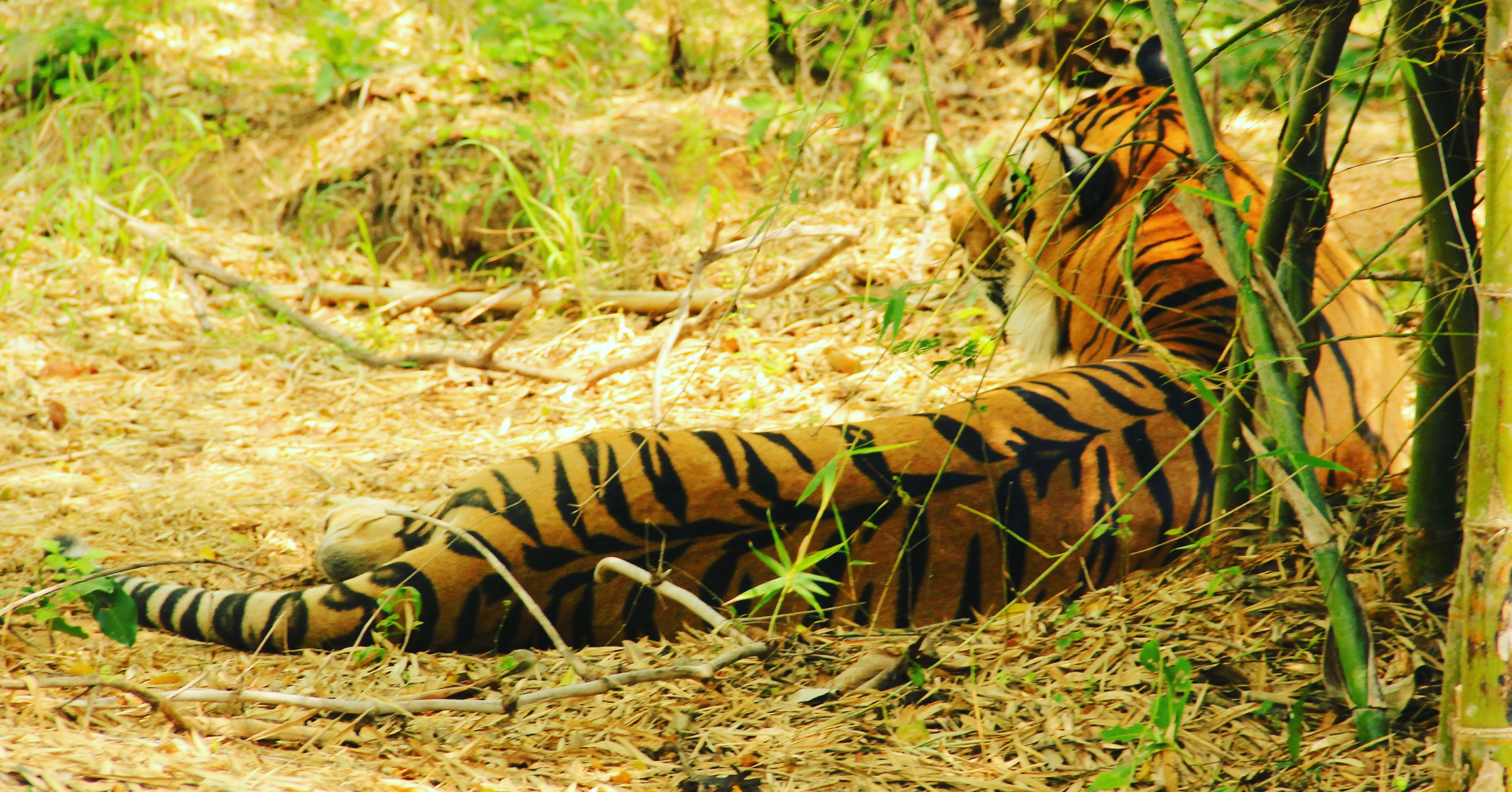
Tigers have ~100 black stripes, each one distinct, and no two tigers share a pattern – like a human thumb. Seen here – an adolescent at Bannerghatta National Park. (Photo from own collection)

There is a 33% jump in numbers (latest count ~3,000 declared by PM Modi on World Tiger Day, July 30, 2019). 50 tiger reserves in 18 states account for 80% of world’s tiger population. The census, an extensive exercise is considered to be the world’s largest wildlife survey. It covered 381,000 sq. km of forested habitats in 18 states where tigers are found in India. A foot survey of 5.22 lakh km was done for tiger signs and prey abundance estimation. A total of 26,838 camera traps resulted in 34.8 million photographs of wildlife, of which 76,651 were of tigers and 51,777 of leopards (livemint.com). In about 2 waking days in the southern-wild, I have seen one pug mark… so deep are our jungles? Mowgli?

While the spurt is a cause for rejoicing, wild animals have to grapple for space not only amongst themselves but also with human greed. Diminishing forest areas including special reserves, due to encroachments (living and farming), transport (rail and road), and Govt grants not to mention poaching – resulting in increasing conflicts and loss of livestock, humans and hunted wild animals. MoEFF’s recent fast-tracking of projects for highways through forests, reducing eco-sensitive zones, green zones, reserve zones, allowing night travel in sensitive areas, etc., aren’t encouraging – however SC has put paid to these efforts by striking down few of the orders passed. Unequal area allocations, lack of proper vegetation in the forests, reduced feedstock in jungles, are also equal cause for concern. Climate change affects them as well – periodical flooding of Kaziranga has taken its toll on the animals within its forest, notably the single-horned Rhino. There are few ngo’s fighting for the cause of these wild ones, increasing awareness among public, and trying their hand in conservation – like cwsindia.org, wti.org.in, wcs.org, www.wpsi-india.org and of course, popular ones like wwfindia.org, bnhs.org, et al.

MoEFCC needs to step in, take cognizance of ground reality and formulate rules for proper administering their policies, empower the Forest dept personnel to fight with with poachers and timber gangs.

As an individual what can you and I do? Next time when travelling to a forest, to stay or a sighting / photography trip, please take care to be responsible – not throw waste, not to feed/leer/jeer/call or disturb any wild animal in its territory, especially not venture near the young ones, if you are lucky to find any. Never buy products related to or sourced out of wild animals, its not only illegal, its unethical. Identify a known organisation and support their cause in wildlife conservation, not necessarily by donating funds. Report an abuse or trade to the nearest police-station / conservator of forests. One Veerappan (dreaded poacher of Western ghats) eliminated will not save the world’s wild!

  • Some astonishing, fun-facts:
  • Tigers grow upto 3.3 mtrs, weigh 300 kgs, and can jump upto 6 mtrs height
  • Unlike cats, they like to play in water and are good swimmers
  • Tiger cubs are born with all the stripes, and the cutesies are very vulnerable, taking upto 2 weeks to see properly (they’re actually blind)
  • Though in 2 months they stop milk and can eat meat, cubs rely on their mother to provide food until around 2 years, while picking up instinctive tricks to hunt/kill
  • Half the cubs born survive beyond 2 years of age, when they move away from their parent, and if they do manage, live for 25 years
  • Not known to be the swiftest, they can still run at 60 kmph!
  • Tigers, though ferocious, are humble beings, hardly roaring unlike Lions
  • Chivalrous males allow their female mate and her cubs to eat first (ironically can kill cubs just to mate with a female) and sometimes, re-hunt for themselves
  • Just 10% of their hunting efforts are successful.
  • A group of Tigers is called an ambush, even if its just a mum with kid.
  • Its said that many tigers are in captivity as there are in the wild (I haven’t counted!)
  • A mix of Tigers and lions are called Liger or Tions, whichever appears obvious – many exist in USA, Czech Republic, China, Iran, Russia, India (?), UAE and Argentina (not just in NatGeo TV channel)
  • A paw swipe can crack a bear’s skull or its back, you’d never want to be on its side

Tigers are graceful, solitary creatures, and just let them be – Our National Icon!