These 18th century imports from Cook Islands in New Caledonia, South-Pacific by Captain Cook were planted in Lalbagh Bangalore around the Band Stand and Glass House. At least one of them is 160m tall and more than 150 years old!! It’s listed as one of the 10 Heritage Trees of Bangalore (a listing of trees ranging from 9-2 centuries old). Distantly related to the real Pines, they’re said to have existed on this earth from the Mesozoic era, feeding the Dinosaurs!
My picture is a replica of a similar photo taken in 1890… published by Deccan Herald in an article written by one of Bangalore’s notable birding expert and an ecologist MB Krishna.
—– As the sun goes down, The shadows lengthen. Another day passes, into obscure oblivion A thousand words, Said and done… A thousand more, Unsaid and drowned.
A tree is up in flames Of bright orange blooms The blazing spring sun Burns a jealous crimson! Birds and bees flock the riot Of more than a thousand flowers As the sprightly fireball traverses horizon…
Sleep eludes the eye On a fullmoon lit fare Fear of the morning after Again losng a day to despair Or running thru night By memories ‘n nightmare A thousand thoughts Cross the cluttered mind
I will arise and go now, and go to Innisfree, And a small cabin build there, of clay and wattles made; Nine bean-rows will I have there, a hive for the honey-bee, And live alone in the bee-loud glade.
And I shall have some peace there, for peace comes dropping slow, Dropping from the veils of the morning to where the cricket sings; There midnight’s all a glimmer, and noon a purple glow, And evening full of the linnet’s wings.
I will arise and go now, for always night and day I hear lake water lapping with low sounds by the shore; While I stand on the roadway, or on the pavements grey, I hear it in the deep heart’s core.
– The Lake Isle of Innisfree – by W. B. Yeats, 1890
The passing of a loved one is traumatic, to say the least. More so if it is a parent, sibling or one’s own kid; even worse if its untimely. Loss in any case is irreplaceable. If an accident would be consoling, a murder is catastrophic!
One score years isn’t a long time, in nature. A quarter of a human lifetime. In actual terms as per a recent SC order it’d be valued at 15L. In real terms, invaluable.
Twenty summers ago, a thin frail twig with bright broad leaves took root. Many said it had no chance, doubted its gender, but she smiled and on she went journeying towards the bright blue sky.
Summer of 2019. 18 yrs later, she blossomed, a beautiful young one with few creamish flowers quickly followed by round honey-golden brown fruits. Next year, Covid lockdown cleared the air; she flowered a lot more and grew to its age, matching its sibling nearby. Her friends around grew taller, stronger. Neither intimidated nor dominant, she was undaunted in her pursuit.
Spring 2021. As with the economy, everything else was looking up too. Few other friends fruited too, for the first time. Many colourful winged friends, large predators, little sunbirds and songbirds, nestled all around.
The world just saw the hottest year ever, helped by the home cooling systems. Himalayan glaciers shrunk further. Meanwhile, a giant iceberg, larger than the size of most European cities, measuring 1,270 sq kms came off the 150-meter-thick Brunt Ice Shelf in Antarctica – repeating its previous years feat.
Back home, something was amiss. On a routine sortie, I found the coolest spot regularly visited wasn’t quite normal. Sunlight wasn’t filtering through dense canopy, rather scorched the earth; a tailor-bird couple that cosily nestled in her bosom was restless, a snake swiftly slithered away and as the dry leaves ruffled, a stub revealed itself. Harsh hacksaw gashes stared back coldly from fresh cut wood. She was gone, murdered! A neighbour lost its limbs. Barbarians had attacked. Heart sank, tears rolled at the ghastly scene. How could someone be so ruthless and unkind! It was devastating. A couple of days I kept visiting, being sorry and heartbroken. It took 20 minutes to hack a 20′ tall 20 yr old tree. Can they not feel the loss of a loved one? I hope.
Then one April friday a week later, through one of the gashes, sprung a new life. It showed her resilience, a willingness to survive and fight for its life. Few baby-green leaves bobbed leaning on me, aided by providential summer breeze. Happy for being alive, thanking for affection and patience. I was sure if not uprooted, she will go on to live five score years or more.
I may not live to see her blossoms again, but her ecosystem will restore. Birds, Bees, Butterflies, Bugs and Squirrels will return to their abode. Song and mirth wPeople will value its produce. Mother Earth will continue to be nourished.
The year 2020 was a lot more cleaner than the previous years with air and water bodies clearing up for a few months; it was also the warmest since 2016.
Pandemic driven lockdowns across the world were one of the reasons for this record, majorly due to increase of greenhouse gasses (GHG) released into the atmosphere.
Air-conditioners are the single most household contributors to the GHGs. AC units funnel heat outside, exacerbating the ‘urban heat island’ effect.
The organic compound Hydrofluorocarbon (HFC) is the primary refrigerant used in air conditioning and refrigeration units. HFCs are a much more potent GHG than carbon dioxide and are leaked anywhere from manufacturing air conditioning equipment, to installation, to the disposal of old units.
Additionally, ~20% of energy produced is used up by the ACs and electric fans accounting for ~70% of peak electricity consumption. Much of the energy used for cooling is generated by burning more carbon-emitting coal and oil.
Prior to the widespread use of hydrofluorocarbons (HFCs), chlorofluorocarbons (CFCs) were used extensively in refrigeration and other applications. It was later linked to ozone depletion. When decomposed by UV radiation in the stratosphere, CFCs released inorganic chlorine, which then destroyed O3 (ozone) compounds. Though phasing out CFCs ensured that the ozone layer is in the process of restoration, the HFCs continue to warm our climate.
The HFC compounds used in AC systems, such as R-410A and R-407C, are over a thousand times more potent than carbon dioxide, establishing them as a significant climate concern.
US and China account for 38% of the world’s ACs; Indian AC market which is a tenth of China’s, is growing at a pace of ~15% yoy and is expected to explode in the next decade – despite fragmented attempts at alternate methods of cooling and adopting vernacular architecture for natural cooling of buildings.
NASA’s article below sheds light on the globally warming climate, with its image of the day on January 16.
—
2020 Tied for Warmest Year on Record
Earth’s global average surface temperature in 2020 tied with 2016 for the warmest year on record, according to an analysis by NASA.
Earth’s average temperature has risen more than 1.2°C (2°F) since the late 19th century. NASA Image of the Day for January 15, 2021 Instrument: In situ Measurement
Continuing the planet’s long-term warming trend, the globally averaged temperature in 2020 was 1.02 degrees Celsius (1.84 degrees Fahrenheit) warmer than the baseline 1951–1980 mean, according to scientists at NASA’s Goddard Institute for Space Studies (GISS). The year was slightly warmer than 2016 but within the margin of error of the analysis, making the years effectively tied.
“The last seven years have been the warmest seven years on record, typifying the ongoing and dramatic warming trend,” said GISS Director Gavin Schmidt. “Whether one year is a record or not is not really that important; the important things are long-term trends. With these trends, and as the human impact on the climate increases, we have to expect that records will continue to be broken.” The map above depicts global temperature anomalies in 2020. It does not show absolute temperatures; instead, it shows how much warmer or cooler each region of Earth was compared to the baseline average from 1951 to 1980. The bar chart below shows this year in the context of the past 140 years in the modern temperature record. The values represent surface temperatures averaged over the entire globe for the year.
The image here shows the seasonal cycle in global temperature anomalies for every month since 1880. Each line shows how much the global monthly temperature was above or below the global mean of 1980–2015.
Like all scientific data, these temperature findings contain a small amount of uncertainty—in this case, mainly due to changes in weather station locations and temperature measurement methods over time. The GISS temperature analysis (GISTEMP) is accurate to within 0.1 degrees Fahrenheit, with a 95 percent confidence level for the most recent period.
While the long-term trend of warming continues, a variety of events and factors contribute to any particular year’s average temperature. The largest source of year-to-year variability in global temperatures typically comes from the El Nino-Southern Oscillation (ENSO), a naturally occurring cycle of heat exchange between the ocean and atmosphere. While the year ended in a La Niña (cool) phase of ENSO, it started in a slightly positive (warm) phase, which marginally increased the average overall temperature. The cooling from the negative phase is expected to have greater influence on 2021.
“The previous record warm year, 2016, received a significant boost from a strong El Niño,” Schmidt said. “The lack of a similar assist from El Niño this year is evidence that the background climate continues to warm due to greenhouse gases.”
Parts of Earth are warming faster than others, with warming trends most pronounced in the Arctic. According to Schmidt, the region has been warming more than three times as fast as the rest of the globe over the past 30 years. At the same time Arctic sea ice has been declining by about 13% per decade, which causes the region to reflect less sunlight (lower albedo). In turn, the Arctic Ocean absorbs more heat and causes temperatures to rise further still. This phenomenon is known as Arctic amplification.
Warmer Earth means more instances of erratic seasons with extreme swings leading to swelling or drying up of rivers and rising ocean levels, severely impacting agriculture and displacing millions worldwide.
All is still not lost; attempts at mitigating climate change is in the hands of people who caused it, though damage-repair is gradual and may take decades.
Incremental, but decisive efforts by individuals adopting a sustainable lifestyle is just one of the means towards a better Earth for now and for future.
– From the NASA, Climate.org and other known sources
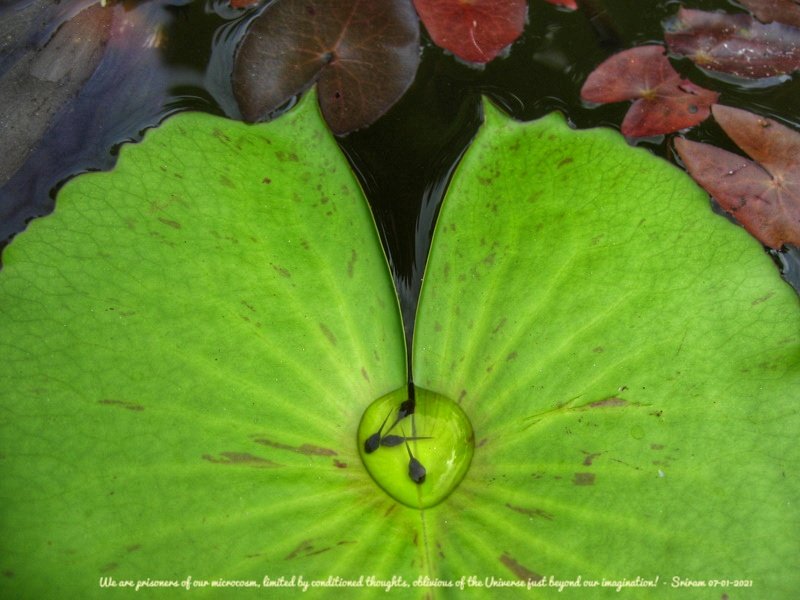
We are the prisoners of our microcosm, jostling for space, limited by our conditioned thoughts, oblivious of the Cosmic universe just beyond our imagination!





 Wise | OtherWise