Ikigai – Reason to Live, Happily

This dwells on self-improvement, and sheds new light on an age old theory – To find life’s purpose and reason is key to being happy.

Success Mantra

This Japanese secret to a longer and happier life is gaining attention around the world. In Japan, the secret to living a longer, happier and more fulfilled life can be summed up in one word: Ikigai.

In Japanese, iki means “to live” and gai means “reason” — in other words, your reason to live. This ideology dates to the Heian period (A.D. 794 to 1185), but only in the past decade has it gained attention from millions around the world.

The ikigai way of life is especially prominent Okinawa, in a group of islands south of mainland Japan. (It has also been nicknamed the “Land of Immortals” because it has among the longest lifespans and highest rates of centenarians in the world.)

‘The reason for which you wake up in the morning’

In a 2009 TED talk called  “How to Live to Be 100+,” award-winning journalist Dan Buettner explores the lifestyle traits of five places in the world where people live the longest. Of all the  “blue zones,” as Buettner defines them, Okinawans have the highest life expectancy. (The video has since been viewed close to four million times.)

“In America, we divide our adult life into two categories: Our work life and our retirement life,” he says. “In Okinawa, there isn’t even a word for retirement. Instead there’s simply ‘ikigai,’ which essentially means ‘the reason for which you wake up in the morning.’”

Buettner cites the ikigai of several Okinawans: For a 101-year-old fisherman, it was catching fish for his family three times a week; for a 102-year-old woman, it was holding her tiny great-great-great-granddaughter (which she said was “like leaping into heaven”); for a 102-year-old karate master, it was teaching martial arts. Woven together, these simple life values give clues as to what constitutes the very essence of ikigai: A sense of purpose, meaning and motivation in life.

The health benefits of ikigai

For years, researchers have tried to find the reasons behind a long and healthy life. While the answer is likely a mix of good genes, diet and exercise, studies have suggested that finding meaning in life is also a key component.

In a 2008 study from Tohoku University, researchers analyzed data from more than 50,000 participants (ages 40 to 79) and found that those who reported having ikigai in their lives had reduced risks of cardiovascular diseases and lower mortality rates. Put another way, 95% of respondents who had ikigai were still alive seven years after the initial survey compared to the 83% who didn’t.

It’s impossible to tell whether ikigai guarantees longevity in life through this single study, but the findings suggest that having a sense of purpose can encourage one to build a happy and active life.

Finding your inner ikigai

There’s no single way to find your ikigai, but you can start by asking a few simple questions: What makes you happy? What are you good at? What (and who) do you value? What motivates you to get up in the morning?

Finding your ikigai will take time. The secret, I often tell people, is to learn the five core pillars of ikigai (which I discuss in my book, “Awakening Your Ikigai”). By applying these pillars to your life, you can allow your inner ikigai to flourish.

1. Starting small – Starting small and executing every step with care is the very ethos of this pillar — and it applies to everything you do in life. Artisanal farmers, for example, devote all their time and effort into creating the best and tastiest produce. They get the soil right. They prune and water their produce with care. Their sense of starting small propels them to go incredible lengths.

2. Releasing yourself – When you release yourself, you’re able to let go of your obsessions and see things that matter to you in a more clear and positive light. Practicing self-acceptance is vital to this pillar — and yet, it’s also one of the most difficult tasks we face in our lives. But if you can overcome this obstacle and be happy with who you are, it can be an incredibly rewarding experience.

3. Harmony and sustainability – You can’t achieve your goals if you’re constantly fighting with the people around you. Cultivating — and maintaining — a sense of community will provide you with a strong support system to carry you through life’s most challenging moments.

4. The joy of small things – Finding joy in the small things — the morning air, a cup of coffee or the ray of sunshine — should be part of what motivates you to get up each morning. In high school, I would take the same 6:20 a.m. train to class every day. The sight the same familiar faces enjoying a game of shogi (Japanese chess) always gave me immense joy.

5. Being in the here and now – This pillar is perhaps the most profound. To be in the here and now, it’s important to focus on the present and practice mindfulness every day. Many sumo wrestlers testify that being in the here and now is absolutely necessary in preparing for and fighting in a bout. They claim that immersing themselves in the present helps sustain their state of mind for optimum performance.

Other inferences that can be drawn from the concept of Ikigai is to be passionate about what you do, even if it may seem insignificant; have a purpose or even several purposes; and celebrate little things.

Ken Mogi is a neuroscientist, best-selling author and lecturer based in Tokyo, Japan. He has published more than 30 papers on cognitive neuroscience. Awakening your Ikigai is his first book in English

Blue Mormon – The Stately

Butterflies are the candies of nature. They not only appear beautiful, but also help the ecology – by pollinating flowers and ensuring continuity to the nature’s cycle.

The butterfly featured here is Blue Mormon, Papilio polymnestor. A large swallowtail butterfly (wing-span of 12~14 cms) commonly found in South of India and Sri Lanka. (Australasia / IndoMalaya ecozone). They are recorded as pollinators of Cardamom (Elettaria cardamomum).

Blue Mormons, the second largest and commonly sighted butterfly in India occur through the year, most prolific after rains during Sept~Nov. These butterflies – with rich velvety black wings, large light blue / white hindwings with spots – are found in gardens, landscapes and orchards with Citrus and Murraya trees – most common in heavy rainfall areas such as rainforests; also found woody urban spaces due to availability Larval host plants. Flowers like Ixora, Jasmine, Foxglove and Indian atlantia are a few favourites. They fly rapidly in unidirection hopping and changing course abruptly.

Blue Mormon is the State Butterfly of Maharashtra – the first such butterfly to be accorded such status, and the first state in India to declare one such, on June 22, 2015.

Blue Mormon – Papilio polymnestor

Female mormons have a light red stripe near its neck, the only differentiator between the genders. These are one of the butterflies known for mud-puddling (suck nutrients out of mud/soil). It was identified in 1775 by Cramer.

Eat Right

One thing that has gained on popularity in the past couple of years other than climate change, is – Millets, a staple crop of hot, arid, semi-arid, sub-humid areas for humans and animals as well. It is the 5th most produced cereal in the world. Millet is the name given to a group of cereals other than wheat, rice, maize & barley.

Millets are rich in minerals, vitamins, and packed with dietary source of nutrients. Every other doctor, nutritionists, news articles, health magazines scream of its goodness and suggest recipes to the millennials. Exclusive millet serving restaurants have mushroomed across Metro cities

Millet, the wonder grain: They are said to be anti-acidic and gluten-free and fibre-rich, help prevent type-2 diabetes, breast cancer, aids in weight loss, reducing blood pressure and risk of gastro-intestinal problems like gastric ulcers/colon cancer, celiac disease, aids sleep y reducing stress, slows muscle degeneration, protects the heart, detoxify body, eliminates problems like constipation, excess gas, bloating and cramping, its antioxidants are anti-ageing, aids breast-milk production, improves skin elasticity – The Wonder Grain

There are six Indian native varieties – Sorghum, Pearl, Finger, Foxtail; in fact, they find mention in the Yajurveda: foxtail millet (priyangava), Barnyard millet (aanava) and black finger millet (shyaamaka) – written in ~4,500 BC!! Below are common Indian names:

EnglishHindiKannadaTamilTeluguBengali
SorghumJowariJolaCholamJonnaJowar
Pearl MilletBajraSajjeKambuSajjaBajra
Finger MilletRagi, MandikaNagli, NachniRagi, KelvaraguRagi, ChodiMarwa
Foxtail milletKakumNavaneTenaiKorraKaon
Barnyard MilletSanwaOodaluKuthirai vollyUdalu, Kodi samaShyama
Kodo MilletKodonHarkaVaraguArika, ArikeluKodo
Little MilletKutki, ShavanSame, SaveSamaiSamaluSama
Proso milletChena, BarriBaraguPani varaguVarigaCheena

In India, cultivation is in low-fertile land, mountainous, tribal and also some rain-fed areas. These areas include Andhra Pradesh, Chhattisgarh, Gujarat, Haryana, Madhya Pradesh, Rajasthan, Maharashtra, Karnataka, Uttar Pradesh, Tamil Nadu and Telangana. In the pre-Green Revolution era, in 1965-66, millets were cultivated in 36.90 million hectares. In 2016-17, the area under millet cultivation declined to 14.72 million hectares (60% less) due to change in consumption pattern, dietary habits, unavailability of millets, low yield, less demand and conversion of irrigated area for cultivation of cash crops like rice and wheat. The crops are tolerant to drought, photo insensitive and resistant to climate change. The cultivation of millets requires less water than that of paddy or wheat. To promote this miracle coarse cereal, Govt of India declared 2018 as The Year of Millets!

Caution on Nutrition – As in all things good, anything in excess is bad. While there are a million websites listing the benefits, nutritional qualities of millets, a few of them also list the side-effects:

  • delays assimilation of iodine, leading to deficiency
  • goitrogen suppresses thyroid stimulating hormone, leads to goitre, especially women with hypothyroidism should avoid or take millets in little quantities. cooking longer increases goitrogens!
  • Pearl millets among others, are rich in oxalates, which could lead to kidney stones
  • Enzyme inhibitors bind minerals from easy absorption by the body
  • Phytic acid leads to bad bone health, and tooth decay, and also block absorption of iron and magnesium. lemon juice and soaking in water arrests effects of this acid.
  • by nature, millets have heating properties. mixing with other cereal like moong dal / green-gram will balance the effects.

There is no need to switch completely to millets; add a lot of vegetables, mix with other pulses in your food, continue to use red/ unpolished rice, whole wheat, and regular exercise to keep fit. Moderation is the key, even with a miracle grain.

info collated from various sources, incl. Indian Institute of Millets Research

National Animal

November 18 is a red letter day for our national animal.

It was on this day in 1972, The Royal Bengal Tiger was conferred the title of National Animal. Panthera tigris as it named in Latin, has the combination of grace, strength, agility and enormous power earning its pride of place as the national animal of India.

The largest in cat family, it has eight sub-species – Royal Bengal, Indo-Chniese, Sumatran, Amur/Siberian, South China, Caspian, Java and Bali, with last 3 being extinct.

In 1972, when the Tiger was elevated to a national symbol, its population was ~1,827 (using pugmark method, which is not considered as reliable). Thirty-eight years later, in 2010, camera-trap method was utilised to conduct a nation-wide census, which recorded just 1,706 across India in an area of 72,800 sq.kms, setting off alarm bells – both for tiger’s numbers as well as the dwindling area (of ~20,000 sq.kms) in reserve forests.

In 2014, the National Tiger Conservation Authority declared that India’s tiger population had bounced to 2,226, from a low of 1,411 in 2006 when the entire tiger population in Rajasthan was wiped out; in South, the forests of Western ghats in Mudumalai, Bandipur, Nagarhole and Wayanad, have the world’s largest tiger population concentrated in a single region, estimated at ~570 tigers. India now has 70% of world’s tiger population. The extent of land area occupied by Tigers is estimated at less than 11,84,911 sq kms, consisting of both reserves and non-reserved areas.

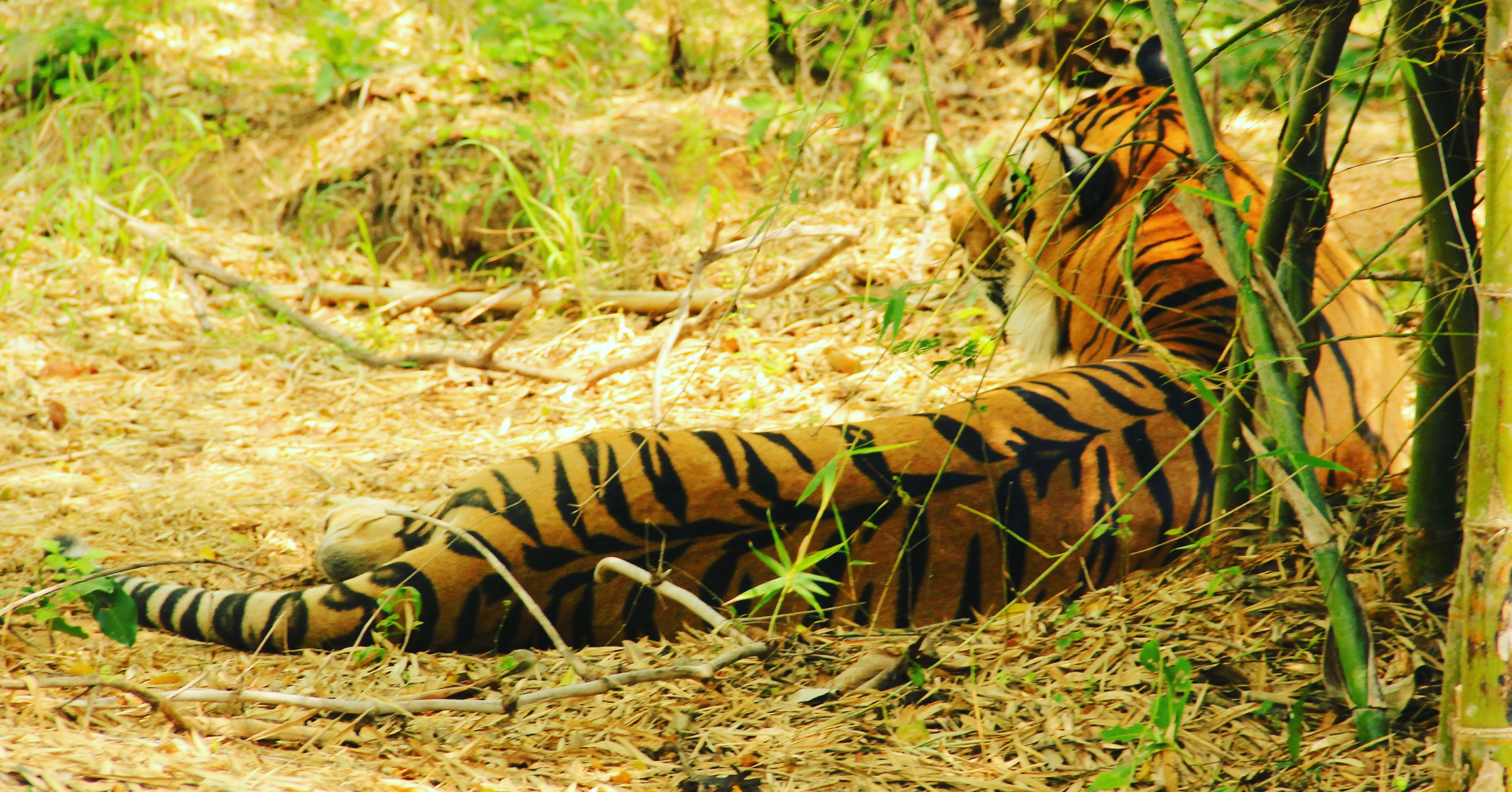
Tigers have ~100 black stripes, each one distinct, and no two tigers share a pattern – like a human thumb. Seen here – an adolescent at Bannerghatta National Park. (Photo from own collection)

There is a 33% jump in numbers (latest count ~3,000 declared by PM Modi on World Tiger Day, July 30, 2019). 50 tiger reserves in 18 states account for 80% of world’s tiger population. The census, an extensive exercise is considered to be the world’s largest wildlife survey. It covered 381,000 sq. km of forested habitats in 18 states where tigers are found in India. A foot survey of 5.22 lakh km was done for tiger signs and prey abundance estimation. A total of 26,838 camera traps resulted in 34.8 million photographs of wildlife, of which 76,651 were of tigers and 51,777 of leopards (livemint.com). In about 2 waking days in the southern-wild, I have seen one pug mark… so deep are our jungles? Mowgli?

While the spurt is a cause for rejoicing, wild animals have to grapple for space not only amongst themselves but also with human greed. Diminishing forest areas including special reserves, due to encroachments (living and farming), transport (rail and road), and Govt grants not to mention poaching – resulting in increasing conflicts and loss of livestock, humans and hunted wild animals. MoEFF’s recent fast-tracking of projects for highways through forests, reducing eco-sensitive zones, green zones, reserve zones, allowing night travel in sensitive areas, etc., aren’t encouraging – however SC has put paid to these efforts by striking down few of the orders passed. Unequal area allocations, lack of proper vegetation in the forests, reduced feedstock in jungles, are also equal cause for concern. Climate change affects them as well – periodical flooding of Kaziranga has taken its toll on the animals within its forest, notably the single-horned Rhino. There are few ngo’s fighting for the cause of these wild ones, increasing awareness among public, and trying their hand in conservation – like cwsindia.org, wti.org.in, wcs.org, www.wpsi-india.org and of course, popular ones like wwfindia.org, bnhs.org, et al.

MoEFCC needs to step in, take cognizance of ground reality and formulate rules for proper administering their policies, empower the Forest dept personnel to fight with with poachers and timber gangs.

As an individual what can you and I do? Next time when travelling to a forest, to stay or a sighting / photography trip, please take care to be responsible – not throw waste, not to feed/leer/jeer/call or disturb any wild animal in its territory, especially not venture near the young ones, if you are lucky to find any. Never buy products related to or sourced out of wild animals, its not only illegal, its unethical. Identify a known organisation and support their cause in wildlife conservation, not necessarily by donating funds. Report an abuse or trade to the nearest police-station / conservator of forests. One Veerappan (dreaded poacher of Western ghats) eliminated will not save the world’s wild!

  • Some astonishing, fun-facts:
  • Tigers grow upto 3.3 mtrs, weigh 300 kgs, and can jump upto 6 mtrs height
  • Unlike cats, they like to play in water and are good swimmers
  • Tiger cubs are born with all the stripes, and the cutesies are very vulnerable, taking upto 2 weeks to see properly (they’re actually blind)
  • Though in 2 months they stop milk and can eat meat, cubs rely on their mother to provide food until around 2 years, while picking up instinctive tricks to hunt/kill
  • Half the cubs born survive beyond 2 years of age, when they move away from their parent, and if they do manage, live for 25 years
  • Not known to be the swiftest, they can still run at 60 kmph!
  • Tigers, though ferocious, are humble beings, hardly roaring unlike Lions
  • Chivalrous males allow their female mate and her cubs to eat first (ironically can kill cubs just to mate with a female) and sometimes, re-hunt for themselves
  • Just 10% of their hunting efforts are successful.
  • A group of Tigers is called an ambush, even if its just a mum with kid.
  • Its said that many tigers are in captivity as there are in the wild (I haven’t counted!)
  • A mix of Tigers and lions are called Liger or Tions, whichever appears obvious – many exist in USA, Czech Republic, China, Iran, Russia, India (?), UAE and Argentina (not just in NatGeo TV channel)
  • A paw swipe can crack a bear’s skull or its back, you’d never want to be on its side

Tigers are graceful, solitary creatures, and just let them be – Our National Icon!

Ideal Village, Khadi and Swaraj

Gandhiji had deep insights and plans to bring about a positive change to Bharat as it existed during his time; he had indeed spelt out the framework with which to achieve true Swaraj, or self-rule, and empowerment to India and its citizens. India, an traditional agrarian economy, adept in the skill of the hand and passed down knowledge for generations earlier, was to transform into a cohesive nation, a global economy growing on its deep rooted wisdom, by learning new tricks of trade and above all, inclusive societal development, without barriers. In his magazine the Harijan he write about how an Ideal Village could take shape and dovetail the growth, but also laments about what could have been and how to be redeemed.

An ideal Indian village will be so constructed as to lend itself to perfect sanitation. It will have cottages with sufficient light and ventilation built of a material obtainable within a radius of five miles of it. The cottages will have courtyards enabling householders to plant vegetables for domestic use and to house their cattle. The village lanes and streets will be free of all avoidable dust. It will have wells according to its needs and accessible to all. It will have houses of worship for all, also a common meeting place, a village common for grazing its cattle, a co-operative dairy, primary and secondary schools in which industrial education will be the central fact, and it will have Panchayats for settling disputes. It will produce its own grains, vegetables and fruit, and its own Khadi. This is roughly my idea of a model village…I am convinced that the villagers can, under intelligent guidance, double the village income as distinguished from individual income. There are in our villages in­exhaustible resources not for commercial purposes in every case but certainly for local purposes in almost every case. The greatest tragedy is the hopeless un­willingness of the villagers to better their lot.

My ideal village will contain intelligent human beings. They will not live in dirt and darkness as animals. Men and women will be free and able to hold their own against anyone in the world. There will be neither plague, nor cholera, nor smallpox; no one will be idle, no one will wallow in luxury. Everyone will have to contribute his quota of manual labour…. It is possible to envisage railways, post and telegraph…and the like…

Khadi and Spinning

Khadi to me is the symbol of unity of Indian humanity, of its economic freedom and equality and, therefore, ultimately in the poetic expression of Jawaharlal Nehru, ‘the livery of India’s freedom’.
Moreover, Khadi mentality means decentralization of the production and distribution of the necessaries of life. Therefore, the formula so far evolved is, every village to produce all its necessaries and a certain percentage in addition for the requirements of the cities.

Production of Khadi includes cotton growing, picking, ginning, cleaning, carding, slivering, spinning, sizing, dyeing, preparing the warp and the woof, weaving, and washing. These, with the exception of dyeing, are essential processes. Every one of them can be effectively handled in the villages and is being so handled in many villages throughout India which the A. I. S. A. (All India Spinners Association) is covering. Imagine the unifying and educative effect of the whole nation simultaneously taking part in the processes up to spinning! Consider the levelling effect of the bond of common labour between the rich and the poor!

The message of the spinning wheel is much wider than its circumference. Its message is one of simplicity, service of mankind, living so as not to hurt others, creating an indissoluble bond between the rich and the poor, capital and labour, the prince and the peasant.

I stand by what is implied in the phrase, ‘unto this last’. We must do even unto this last as we would have the world do by us. All must have equal opportunity. Given the opportunity, every human being has the same possibility for spiritual growth. That is what the spinning wheel symbolizes.

The disease of the masses is not want of money so much as it is want of work. Labour is money. He, who provides dignified labour for the millions in their cottages, provides food and clothing, or which is the same thing, money. The Charkha provides such labour. Till a better substitute is found, it must, therefore, hold the field. Idleness is the great cause, the root of all evil, and if that root can be destroyed, most of the evils can be remedied without further effort. A nation that is starving has little hope or initiative left in it. It becomes indifferent to filth and disease. It says of all reforms, ‘to what good?’ That winter of despair can only be turned into the ‘sun-shine of hope’ for the millions only through the life-giving wheel, the Charkha.

The spinning wheel is an attempt to produce something out of nothing. If we save sixty crores of rupees to the nation through the spinning wheel, as we certainly can, we add that vast amount to the national income. In the process we automatically organize our villages.

It is my claim that (by reviving Khadi and other village industries) we shall have evolved so far that we shall remodel national life in keeping with the ideal of simplicity and domesticity implanted in the bosom of the masses. We will not then be dragged into an imperialism which is built upon exploitation of the weaker races of the earth, and the acceptance of a giddy materialistic civilization protected by naval and air forces that have made peaceful living almost impossible. When once we have revived the one industry (Khadi), all the other industries will follow. I would make the spinning wheel the foundation on which to build a sound village life; I would make the wheel the centre round which all other activities will revolve.

The ideal of Khadi has always been as a means, par excellence, for the resuscitation of villages and therethrough the generation of real strength among the masses—the strength that will ipso facto bring Swaraj.

Our work had a very humble beginning. When I started Khadi I had with me, apart from Maganlalbhai and others who had elected to live and die with me, Vitthaldasbhai and a few sisters. We have travelled a long way since then and today about two crores of people have come under the influence of the Charkha. By its help we have been able to provide the village people with a large amount of money. But can we still hold, as we have always maintained, that Swaraj is impossible without the Charkha? So long as we do not substantiate this claim the Charkha is really no more than a measure of relief, to which we turn because we can do nothing else about it. It would not then be the means of our salvation.

Secondly, we have failed to carry our message to the crores of our people. They have neither any knowledge of what the Charkha can do for them nor even the necessary curiosity for it.”

Well, I am no Gandhian, nor a scholar with deep insights into his thoughts. I feel, the great man was both practical and futuristic at the same time and that is his greatness, to be relevant even after a hundred-odd-years. We as a nation have failed as followers of the Mahatma. It is very easy to be dismissive and become pessimistic, given the state of the affairs today. But, there is still scope for espousing the cause, rekindling the dream of Swaraj and bring about a positive change in the society. It is not for the government/s to drive the change, but we, as patriotic individuals have the power and the responsibility to re-ignite the nationalism in our own homes, little community silos, starting in simple ways, which could dovetail and spread to the society, state, and the nation. Notes to follow will dwell on such thoughts.

Comments are most welcome. Dialogues enhance knowledge.

– Excerpts from Gandhiji’s writings in Harijan, Young India, 1926~42; mkgandhi.org

SUSTAIN – Environment

Air Pollution is responsible for the premature deaths of approximately 7 million people worldwide each year, with about 4 million of these deaths occurring in Asia-Pacific, and 1.2 million in India alone.

How much pollution we breathe in is dependent on many factors, such as access to clean energy for cooking and heating, the time of day and the weather. Rush hour is an obvious source of local pollution, but air pollution can travel long distances, sometimes across continents on international weather patterns.

The theme of World Environment Day 2019 is “Beat Air Pollution”. Started in 1974, World Environment Day highlights various factors that affect the environment and the resultant destruction that is caused. It is a reminder to all citizens to become aware of the alarming factors and adopt sustainable measures to mitigate the damage already caused to our Earth and ensure that the future is made safer.

Air Pollution facts:

  • 92 per cent of people worldwide do not breathe clean air
  • Air pollution costs the global economy $5 trillion every year in welfare costs
  • Ground-level ozone pollution is expected to reduce staple crop yields by 26 per cent by 2030

Human activity interferes with environment’s ability to regenerate and renew itself. Nobody is safe from this pollution, which comes from five main human sources. Household, Industry, Transport, Farming and Waste. These sources spew out a range of substances including carbon monoxide, carbon dioxide, nitrogen dioxide, nitrogen oxide, ground-level ozone, particulate matter, sulfur dioxide, hydrocarbons, and lead – all of which are harmful to human health.

Household – main source of air pollution at home is the burning of fossil fuels. Lack of access to clean energy and safe equipment to cook, heat/cool and light homes causes indoor air pollution – affecting 3.8 million people worldwide.

While governments push for cleaner methods of cooking (LPG, biogas, electric, etc), adopting the most commonly available alternate resources that do not cause pollution is the responsibility of us, citizens. Avoiding usage of materials/products that contain solvents and propellants, release toxic aerosols, when inhaled lead to fatal illnesses (hairspray, paints, fabric protector, cleaning products, deodorants, room deodorizers, air freshening sprays, fumes from reused oils) – can control indoor air-pollution.

Industry – In many countries, energy production is a leading source of air pollution. Coal-burning power plants are a major contributor, while diesel generators are a growing concern in off-grid areas. Industrial processes and solvent use, in the chemical and mining industries, also pollute the air.

Alternate sources of generating power can be the single largest measure to help control industry related emissions. Industries that generate effluents need to treat at source and not store the harmful discharges that release lethal toxins into the atmosphere.

Transport – Globally, transport sector contributes ¼th of CO2 emissions. These emissions have been linked to nearly 400,000 premature deaths and double that figure to dementia. Almost ½ of all deaths of air pollution is directly linked to diesel emissions.

Conscious effort to reduce usage of personal vehicles, promoting use of public transport, adopting fuel-efficient vehicles, are few of the actions that can diminish transport emissions related pollution.

Farming – There are two major sources of air pollution from farming: livestock, which produces methane and ammonia, and the burning of agricultural waste. Methane emissions contribute to ground-level ozone, which causes asthma and other respiratory illnesses. Methane is also a more potent global warming gas than carbon dioxide – its impact is 34 times greater over a 100-year period. Around 24 percent of all greenhouse gases emitted worldwide come agriculture, forestry and other land-use.

There are many ways to reduce air pollution from this source. People can move to a plant-based diet and/or reduce food waste, while farmers can reduce methane from livestock by optimizing feed digestibility and improving grazing and grassland management and avoid burning of agricultural stubble.

Waste – Open waste burning and organic waste in landfills release harmful dioxins, furans, methane, and black carbon into the atmosphere. Globally, an estimated 40% of waste is openly burned. The problem is most severe in urbanizing regions and developing countries. Open burning of agricultural and municipal waste is practiced in 166 out of 193 countries.

Improving the collection, separation, and disposal of solid waste reduces the amount of waste that is burned or landfilled. Separating organic waste and turning it into compost or bioenergy improves soil fertility and provides an alternative energy source. Reducing the estimated one-third of all food that is lost or wasted can also improve air quality.

Other sources – Not all air pollution comes from human activity. Natural calamities and occurrences such as volcanic eruptions, dust storms and other natural events also cause Air pollution problems. Sand and dust storms are equally concerning. Fine particles of dust can travel thousands of miles through these storms, which may also carry pathogens and harmful substances, causing acute and chronic respiratory problems.

While it may be impossible to control natural disasters, human actions that aggravate such activities (mining, deforestation,

Our Environment has the capability to restore itself, for all natural causes of pollution. We, as responsible citizens, can take additional, simple measures that can help the environment in its efforts to clean the Earth.

Carbon sequestration by afforestation (a natural process by which pollutants are absorbed by trees and water bodies from the atmosphere) is a sure and cost effective means to mitigate air pollution and climate change, in addition to sustainable practices enumerated above. During photosynthesis, trees absorb CO2 from the atmosphere and later use it to build trunks, stems and roots; one tonne of carbon stored in a tree translates into 3.67 tonnes of carbon removed from the atmosphere and release of 2.67 tonnes of oxygen! Currently, forests store 45% of all land carbon. An estimated 35 billion tonnes of CO2 are produced by human activities and natural processes are absorbing just half of it; the remaining contributes to climate change.

A study by IISc, estimates, cities account for 78% of carbon emissions, and urban forests act as carbon sinks; WHO recommends 9.5 sqm of greenspace per person in an urban environment. Native trees that last long and have high wood density (Banyan, Neem, Tamarind Madhuca, Arjuna…) along with native fast growing trees (Teak, Mahogany, Bakul, Gulmohur…) are ideal choices rather than exotic/introduced species. Eg: GEER (Gujarat Ecological Education and Research) found that a Teak tree can absorb 3.70 lakh tonnes of CO2 in its lifetime of 50 yrs!

In addition to large trees, shrubs, plants, and grasses, as also water bodies help in reducing air pollution. Along with sustainable personal practices, every person must aim to plant at least 10 trees, to mitigate own causes of carbon emissions and help clean Our Earth.

Short videos: Air Pollution 101 | National Geographic

Awareness is a start – Action is the result!

compiled from various online sources and books, including UN-Environment’s greeningtheblue.org

SUSTAIN – Health

Yoga is derived from the Sanskrit root word ‘yuj’ which means ‘join’ or ‘unite’. It’s the union of body, mind and soul.

Health is a positive notion. Positive health is a jubilant and energetic feeling of well-being, resulting in freedom from illness and disease. Yoga is a method, a holistic system that aids in enhancing positivity and wellness of a person. It helps in developing strength, stamina, endurance and high energy at physical level. It also empowers oneself with increased concentration, calm, peace and contentment mentally, leading to inner and outer harmony.

There are various techniques to follow and perform – Pranayama (breathing), Asana (postures), Kriya (cleansing), Dhyana (meditation), and other higher forms of practice. Each of these can be performed at various levels, for starters, we will look at simple steps that’s easy and doable daily.

Pranayama – A breathing technique that focuses on increased oxygen inhalation and carbon-di-oxide exhalation. There are three phases of Pranayama – puraka, rechaka and kumbhaka. Puraka is controlled inhalation; rechaka is controlled exhalation and kumbhaka is controlled retention of breath. It is said that an average person uses only 30% of the lungs’ capacity. This can easily be doubled by practicing Pranayama; sustained long-term practice can improve furthermore. This internal cleansing increases positivity / mental wellbeing and lowers blood-pressure.

Asana – Postures, that help in keeping body fit and to develop strength, flexibility and balance. Asanas number in hundreds – each one with specific purpose to gives stability and comfort, both at physical and mental level. Regular practice of Asanas are believed to help the heart and eliminate diseases caused by being sedentary and unhealthy lifestyle choices.

The most commonly performed set of asanas is Surya Namaskar (sun-salutation). These are detailed here below, Page 2 onwards.

Kriya – means Action, directed at specific organs of the body that cleanses and detoxifies each of them. Shatakarma, or six cleansing processes (viz, Neti, Dhauti, Basti, Trataka, Nauli, Kapalabhati and Agnisara) using air, water and the organs themselves as a tool. Kriya requires to be practiced after obtaining training from a learned Guru, an expert in yogic practices.

Dhyana – means concentration; to increase awareness and strength of the mind by focusing one’s thought. By concentrating on one point, regularly, the mind is trained to be stable, eliminate negative emotions like fear, anger, depression, anxiety, and increase clarity of thought and will-power.

Surya Namaskar or Sun Salutation is a set of 12 powerful yoga asanas (postures) which is a great workout method, an excellent way to stay fit. All you need is willing mind and a mat!

Ideally done at sunrise, facing east, these asanas can be done at your own pace, each with its own benefit. The 3-speed variations can help you get optimum benefits of Surya Namaskar:

Slow pace        : to stay fit and keep the body flexible

Medium pace  : useful for toning your muscles and improve metabolism

Fast pace         : an excellent cardiovascular workout and aids in weight loss

Now let’s learn the Surya Namaskar –

1. Pranamasana Om Mitraya Namaha The Prayer Pose Pranamasana is the start of Surya Namaskar. Join your feet and stand upright balancing your weight equally on both feet. Bring your palms in front and combine so that they touch your chest. Close your eyes. And let your body relax. While you inhale, raise your arms from the sides. And as you exhale, join your palms together in front of your chest as in praying. This is the Pratham Namaskar or first salutation towards the sun. Relaxes body and mind.
2. Hastauttanasana Om Ravayé Namaha   The Raised Arms Pose Keeping the palms joined in the previous prayer position, breathe in and lift your arms up and bend backwards slightly. Arms shoulder-wide apart. This posture is to loosen up by stretching the entire body. Stretches the chest and abdomen, lifts energy up through the body.
3. Padahastasana   Om Suryāya Namaha   The Hand-to-Foot Pose While standing upright, breathe out, and bend forward from the waist. Go down and touch the ground but keeping your spine straight as much as possible. Do this as your exhale slowly and completely. Massages abdomen, increases digestive power and blood flow to brain, stretches spine, thigh muscles
4.
Ashwa Sanchalanasana Om Bhānavé Namaha
The Equestrian Pose Now breathe in, and stretch your body parallely to the ground. Keep your hands to the side, and bring your right knee towards the right part of the chest and let your left leg stretch behind. Look up. Stretches quadriceps, pelvic muscles and spine, stimulates abdominal organs, increases mental prowess
5.
Dandasana   Om Khagāya Namaha  
The Stick Pose As your inhale, fling your right leg also backwards aligning your entire body parallely to the ground. Improves posture, strengthens back muscles and spine, stretches shoulders and chest.
6. Ashtanga Namaskara     Om Pūshné Namaha The Eight point salute Stay in Dandasana, gently bring down your knees towards the floor and exhale. Now bring your chin to rest on the floor, keep your hips elevated in the air. Hence, your eight parts (two hands, two knees, chin and chest will rest on the floor while your hip stays elevated in the air). Develops the chest, and strengthens arms and legs.  
7. Bhujangasana Om Hiranya Garbhāya Namaha The Cobra pose. This is simply aligning your chest and torso 90 degrees to the ground, keeping your legs and mid-section flat on the ground. Make sure you use your hands to support your body and are not tempted to transfer your entire weight onto them. Relieves tension in back and spine, stimulates and expands chest and conditions abdominal organs
8. Parvatasana   Om Marichaye Namaha   The Mountain Pose Keep your palm and feet where they are, and slowly raise your mid-section – hips and abdomen. Breathe out as you stretch your legs, spine and arms. Strengthens legs and arms, stretches calf and spine muscles, and relieves varicose veins.
9. Ashwa Sanchalanasana Om Ādityāya Namaha   The Equestrian Pose Now from Parvatasana, return to the ashwa sanchalanasana. But this time, we do the opposite of what we did in the 4th step. Procedure- Bring your right foot forward, while resting the left foot behind, at its original position. Stretches quadriceps, pelvic muscles and spine, stimulates abdominal organs, increases mental prowess
10. Pada hastasana   Om Savitré Namaha The Hand to foot pose Now slowly bring your left foot forward, next to the right foot as you exhale. Keeping the position of your hands intact, lift yourself up to slowly enter Hasta Padasana. Massages abdomen, increases digestive power, blood flow to brain, stretches spine.
11. Hastauttanasana   Om Ārkāya Namaha The Raised Arms Pose Now inhale, raise your hands upward, and bend backward to enter Ardha Chakra Asana, or Hasta-Uttana asana. Massages abdomen, increases digestive power, blood flow to brain, stretches spine.
12. Pranamasana   Om Bhaskarāya Namaha   The Prayer Pose Finally, exhale and stand in a relaxed manner in the namaskara mudra. Feel the positive vibrations in your body.    

This is one set of Surya Namaskar Asanas – best done outdoors, early morning. Ass you can see, each asana has a mantra for the Sun; chanting of the mantra is said to be beneficial, though, is optional.

Twelve repetitions of this holistic exercise are said to yield maximum benefit, i.e., build strength and increase flexibility. Researchers estimate that 30 mins of Suryanamaskar can burn ~400 calories!

Resting after 6 sets, in sukhasana (sitting down cross-legged) is advised for people with poor fitness and elderly. People with any medical condition may consult a doctor before starting to do brisk yoga asanas / surya namaskar.

The Surya Namaskar Circle

SUSTAIN – Act Right

Reigning the monster

Come October 2, 2019 – Government of India is all set to ban single-use plastic in major cities, towns and villages, that rank among the world’s most polluted.

Items such as polythene bags, cups, tumblers, plates, 500ml bottles, straws, sachets, forks, knives and cotton ear buds, are all single use plastics. The ban on the first six items will clip 5% to 10% from India’s annual consumption of about 14 million tonnes of plastic, according to GoI estimates; curbs will also be on e-commerce companies to limit plastic packaging that makes up nearly 40% of the plastic industry. Cigarette butts also are on the anvil – yes, butts contain cellulose acetate, a plastic (not cotton) filter that’s not biodegradable and contains carcinogens from tobacco.

Solid waste management remains a grave challenge given the population and geographic spread; ~25,940 tonnes of plastic waste is generated daily of which 10,000 tonnes remains unsegregated ending up in landfills. In the last decade alone, the world has produced more plastic than in the last century.

Silent killers

While the global focus is on larger single-use-articles, items such as toffee/chocolate/biscuit wrappers, tetrapaks, toothbrushes, toothpaste tubes, razors, sachets that pack anything from chips to tobacco to tea/coffee powder / milk/oil/detergent/condiments/handwash/, even kids toys, footwear and plastic business cards, are silent killers tossed away without realizing their potential to damage our environment as much as plastic bags / straws. These articles were found to be the major cause of floods at various places in 11 states during recent monsoons, choking the storm water drains and sapping earth of permeability. Mumbai realized way back in 2005 when 315 people were killed due to stagnant water borne diseases following heavy rains and banned plastic bags but not enforced. Delhi followed suit in 2008, never enforced. It’s the same story in Bangalore, Shimla, Tirupati, Pune, Hyderabad, Kozhikode, and all over.

Returned with thanks

Plastics when discarded comes back to us. WWF’s research found that we consume ~250 gms every year. The plastic, the non-biodegradable material disintegrates into micro-particles. These particles leach into streams that water field crops, in our tap-water, and enter salt and aquatic animals from oceans, ultimately ending up on our plate. To know how much plastic we consume, watch yourplasticdiet.org.

The clothes we wear contain upto 60% of synthetic fiber, and estimated that a single load of weekly laundry wash+dry could release 700,000 fibers into water, detergent based pollution is a bonus Polyester fabric recycles once along with PET bottles into polyester yarn; the strands don’t hold well in more recyclings – ending up in landfills or burnt.

Oceanic choke

Great Pacific Garbage Patch is now dwarfed! Increasing evidence shows that all the oceans of the earth are polluted with discarded plastic items. The ocean with the largest amount of plastic is the North Pacific, followed by the Indian Ocean, the North Atlantic, the South Pacific, the South Atlantic and the Mediterranean Sea. Altogether, the 5 trillion pieces of plastic waste in our oceans weighs as much as 268,000 tons, which is equivalent to 38,000 African elephants. Indian Ocean ranks a high 2nd with 1.3 trillion pieces estimated.

Mountains too…

Himalayas, the majestic sentinels of India are ridden with plastic waste, 94% of which is single use plastic / packaging. ‘The Himalayan Cleanup’ was carried out in 12 mountain states of India on May 26, 2018 (Sikkim, West Bengal, Assam, Manipur, Meghalaya, Nagaland, Tripura, Mizoram, Arunachal Pradesh, Himachal Pradesh), involving ~15,000 volunteers of 200 organisations in 250 critical sites. In 2014, trekkers from Nepal removed ~25 tons of trash and 15 tons of human waste, and its increasing year on year.

We can!

Next time you go shopping, try these simple alternates – carry a cotton bag, a metal/glass water-bottle, use public transport, avoid munching on toffees/chips or sipping a tetrapak juice – if you must, hold on till you find a trash can. Look around to buy unpacked-clean groceries, buy natural fiber material / clothes, return plastic packaging from products you buy even from brand stores, its cool! Travel responsibly – carry a trash bag, do not throwaway disposables or broken / unusable items, carry water.

Sustainable Living

Adopting a sustainable lifestyle needs commitment – to explore, experiment, learn, practice continuity and above all, loving. Because beyond all of the frightening news; beyond the frustrating politics; beyond the failed national laws and international agreements, there is one question – how do you want to live your life? We can choose to feel defeated, helpless and frustrated; or choose to be grounded, purposeful and hopeful.

Love for all beings living, and thus living sustainably, requires a complete change in lifestyle, achievable by small simple steps – through the clothes we buy, the energy we use, the food we eat, even the toothpaste we brush our teeth, the soap we bathe with. We have learnt to adopt products and practices without realizing their impact; now that we know, it’s easy to re-adopt to earlier safe practices and clean products.

Every choice we make impacts others – through its creation, its distribution, its use and its disposal. Most likely we’ll never know – or even see – who we are impacting. But they are out there, nonetheless, suffering – or thriving – based on our choices.

Facts and figures collected from across wide web world. Credits at respective places.

SUSTAIN – Deep Thoughts

Gandhiji believed that India had a definite mission to fulfill, he said “An India, awakened and free, has a message of peace and good-will to a groaning world.”

Gram Swaraj

India is made of villages, but our intelligentsia has neglected them… village life must not become a copy or appendage of city life. The cities have to adopt the pattern of village life and subsist for the villages. We must identify ourselves with the villagers who toil under the hot sun beating on their bent backs and see how we would like to drinks water from the pool in which the villagers bathe, wash their clothes and pots, and in which their cattle drink and roll. Then and not till then shall we truly represent the masses and they will as surely as I am writing this, respond to every call.

Laying down the duties of the village worker who naturally occupies the pivotal position in the planning of Village Swaraj of Gandhiji’s conception, he says that the village worker will organize the villages so as to make them self-contained and self-supporting through agriculture and handicrafts, will educate the village folk in sanitation and hygiene and will take all measures to prevent ill-health and disease among them and will organize the education of the village folk from birth to death along the lines of Nai Talim (Nai Talim/New Education, was popularly and correctly described as education through handicrafts, vocational skills that earn gainful livelihood). India lives in its villages, and development of villages will be critical if we want to close the gap between the “haves and have not’s” for better human development.

The cities are capable of taking care of themselves. It is the villages we have to turn to. We have to disabuse them of their prejudices, their superstitions, their narrow outlook, and we can do so in no other manner than that of staying amongst them and sharing their joys and sorrows and spreading education and intelligent information among them. The moment you talk to them (the Indian peasants) and they begin to speak, you will find wisdom drop from their lips. Behind the crude exterior you will find a deep reservoir of spirituality. I call this culture-you will not find such a thing in the West. You try to engage a European peasant in conversation and you will find that he is uninterested in things spiritual. In the case of the Indian villager, an age-old culture is hidden under an entrustment of crudeness. Take away the encrustation, remove his chronic poverty and his illiteracy and you will find the finest specimen of what a cultured, cultivated, free citizen should be.

The village movement is as much an education of the city people as of the villagers. Workers drawn from cities have to develop village mentality and learn the art of living after the manner of villagers. This does not mean that they have to starve like the villagers. But it does mean that there must be a radical change in the old style of life? While the standard of living in the villages must be raised the city standard has to undergo considerable revision, without the worker being required in any way to adopt a mode of life that would impair his health. To serve our villages is to establish Swaraj. Everything else is but an idle dream.

No movement or organization having vitality – dies from external attack. It dies of internal decay. What is necessary is character above suspicion, ceaseless effort accompanied by ever increasing knowledge of the technique of the work and a life of rigorous simplicity. Workers without character, living far above the ordinary life of villagers, and devoid of the knowledge required of them for their work, can produce no impression on the villagers.

I know that the work (of shaping the ideal village) is as difficult as to make of India an ideal country… But if one can produce one ideal village, he will have provided a pattern not only for the whole country but perhaps for the whole world. More than this a seeker may not aspire after.

We stand today in danger of forgetting how to use our hands. To forget how to dig the earth and tend the soil is to forget ourselves. To think that your occupation of the Ministerial chair will be vindicated if you serve the cities only would be to forget that India really resides in her 7,00,000 village units. What would it profit a man if he gained the world but lost his soul into the bargain?

A man whose spirit of sacrifice does not go beyond his own community, himself becomes, and makes his community, selfish. The logical sequel of self-sacrifice is that the individual sacrifices himself for the community, the community for the district, the district for the Province, the Province for the nation, and the nation for the world.

Cleanliness and Sustainability

Mahatma’s oft quoted statement is – “Earth has enough resources for everybody’s need and not for anybody’s greed.”

Gandhiji realized the importance of living close to earth as part of ecosystem. All the buildings here in the Talimi Sangh (Sevagram) are built of local material and with the help of local artisans. We have thereby established a living link between ourselves and the people. That by itself is an education for the people and constitutes the foundation of our future educational work. If you thoroughly assimilate this ideal of simplicity and its importance in the New Education, you will have justified your training here. You will then appreciate your work. That work consists of cleaning up. No dirt could be found anywhere on the ashram ground. All rubbish was buried in pits; peelings of vegetables and left-over food was dumped in a separate manure pit and composted. The night-soil, too, was buried and later used as manure. Waste water was used for gardening. The farm was free from flies and stink though there was no puckka drainage system.

Cleanliness of the mind and body is the first step in education. Prayer does for the purification of the mind what the bucket and the broom do for the cleaning up of your physical surroundings. That is why we always commence our proceedings with prayer. No matter whether the prayer we recite is the Hindu prayer or the Muslim or the Parsi, its function is essentially the same, namely, purification of the heart. God has innumerable names but the most beautiful and suitable in my opinion is Truth. Let Truth, therefore, rule every action of our life, be it ever so insignificant. Let every morsel of food that we eat be sanctified with His name and consecrated to His service. If we eat only to sustain the body as an instrument of His service not only will it make our bodies and minds healthy and clean, the inner cleanliness will be reflected in our surroundings also. We must learn to make our latrines as clean as our kitchens.

As with the individual so with society. A village is but a group of individuals and the world, as I see it, is one vast village and mankind one family. The various functions in human body have their parallel in the corporate life of society. What I have said about the inner and outer cleanliness of the individual, therefore, applies to the whole society. In the mighty world, man, considered as an animal, occupies but an insignificant place. Physically, he is a contemptible worm. But God has endowed him with intellect and the faculty of discrimination between good and evil.

Khadi

Khadi to me is the symbol of unity of Indian humanity, of its economic freedom and equality and, therefore, ultimately in the poetic expression of Jawaharlal Nehru, ‘the livery of India’s freedom’, said Gandhiji. Moreover, Khadi mentality means decentralization of the production and distribution of the necessaries of life. Therefore, the formula so far evolved is, every village to produce all its necessaries and a certain percentage in addition for the requirements of the cities.

Production of Khadi includes cotton growing, picking, ginning, cleaning, carding, slivering, spinning, sizing, dyeing, preparing the warp and the woof, weaving, and washing. These, with the exception of dyeing, are essential processes. Every one of them can be effectively handled in the villages as is being so handled throughout India. Imagine the unifying and educative effect of the whole nation simultaneously taking part in the processes up to spinning! Consider the levelling effect of the bond of common labour between the rich and the poor! The message of the spinning wheel is much wider than its circumference. Its message is one of simplicity, service of mankind, living so as not to hurt others, creating an indissoluble bond between the rich and the poor, capital and labour, the prince and the peasant.

In Hind Swaraj, he wrote of industrialization at odds with moral values: “The incessant search for material comforts and their multiplication is an evil. I make bold to say that the Europeans will have to remodel their outlook, if they are not to perish under the weight of the comforts to which they are becoming slaves.” Further, with a prophetic vision, Gandhiji warned: “A time is coming when those who are in mad rush today of multiplying their wants, will retrace their steps and say; what have we done?” This is true of climate change and the disasters that the world is facing today due to environment-damaging products and unsustainable activities.

Gandhiji said, “Let’s start with ourselves. I will give you a talisman. Whenever you are in doubt, or when the self becomes too much with you, apply the following test. Recall the face of the poorest and the weakest man whom you have seen and ask yourself: If the step you contemplate is going to be of any use to him. Will he be able to gain anything by it? Will it restore to him control over his own life and destiny? In other words, will it lead to Swaraj for hungry and spiritually starving millions? Then you will find your doubts and yourself melt away”.

We need to recollect these words of the Mahatma every moment. We can learn to live simply so that others can simply live – sharing more and consuming less for the simplified life. Instead of asking the question, why should I, let us ask the question, why should I not? A drop from the ocean perishes without doing any good. As a part of the ocean, it shares the glory of carrying on its bosom whole fleets of mighty ships!

Excerpts from Young India, Harijan, various letters and conversations between 1925~1946, compilations in a book Village  Swaraj, published by  Navjivan Trust.

Green is Good

Well, its no rocket science that Green spaces are good – not only visually, but also for the mind. an early morning walk is a refreshing start, an evening stroll soothes tired eyes and body. However, a new study uses satellite and demographic data to show how the prolonged presence of green space is important for a healthy society.

In a nationwide study, researchers from Denmark’s University of Aarhus found that childhood exposure to green space—parks, forests, rural lands, etc.—reduces the risk for developing an array of psychiatric disorders during adolescence and adulthood. The study could have far-reaching implications for healthy city design, making green space-focused urban planning an early intervention tool for reducing mental health problems.

The impact of green space throughout childhood is significant. Exposure to green space is comparable to family history and parental age when predicting mental health outcomes. Only socioeconomic status was a slightly stronger indicator.

In India, most of us have grown with some greenery around us, especially those areas nearer to the umpteen mountain ranges like, the Western Ghats, the Sahyadris, and to a lesser extent, the Aravallis up north. every village has at least a Neem or a Peepal tree, with some fruit trees like Mango, Jamun and plants like Tulsi, Mehendi as also climbers like Jasmine.

Researchers are still working out exactly why green space is so beneficial, but it clearly provides health benefits across the population. It can encourage exercise, provide spaces for socializing, decrease noise and air pollution, and improve immune function by providing exposure to beneficial microbiota. It also can help with psychological restoration; that is, green space provides a respite for over-stimulated minds.

Green space most strongly protects against mood disorders, depression, neurotic behavior, and stress-related issues, the study found, signaling that psychological restoration may be the strongest protective mechanism that green space offers. The effect of green space is also dose-dependent, meaning those who have longer exposures to green space have greater mental health benefits.

It is an already established fact that green spaces mitigate climate change risks posed by urbanization; now this research based on Denmark’s demographics, adds impetus to the need to increase green cover, necessarily native trees that require low maintenance and live long. Additionally, adopting an environment friendly lifestyle, using products made from sustainable materials, less reliance on fossil fuels, making buildings that are kind to our earth and not reflect heat to atmosphere, could not only benefit, may actually start reversing the mal-effects of 250 yrs of industrialization.

Denmark currently has ~15% of forest cover, down from more than 40% before industrialization. Further extensive initiatives for urban greening and support from Govt for increasing green cover is ensuring that their population stays stress-free for generations to come.

India’s ~21% forest cover is slightly better, but much lesser than the world average of 30% and even the 33% recommended by our National Forest Policy. Considering the density of population and rapid urbanization, sincere efforts to increase green cover by the Govt as well as public is necessary. PM’s advice to each Indian citizen to plant 5 trees, if done, would aid restoring urban greenery, while Govts’ ambitious plan to plant 125 crore trees would start the re-greening of semi-urban and rural areas across India.

The research by Kristune Engemann and others was published in the Proceedings of the National Academy of Sciences. It is the largest epidemiological study to document a positive connection between green space and mental health. This original article was published by NASA’s Earth Observatory online.